
SEO can bring in traffic for months or even years, but traffic alone does not pay the bills. For a business, the real question is whether the money, time, and resources put into SEO are producing enough revenue to justify the investment. Here, SEO ROI comes in!
SEO ROI shows the financial return generated by organic search compared with what the business spends to achieve that result. It brings together organic traffic, conversions, revenue, customer value, and SEO costs to answer a much more useful question than “Did our rankings improve?”
This guide explores SEO ROI and shares useful guidelines to measure, calculate, and improve SEO returns for the business.
Why SEO Is a High-Value Investment
SEO works differently from paid acquisition channels.
When a paid campaign stops, the traffic attached to that budget usually stops as well. SEO assets, however, continue producing value after the original work has been completed.
A useful service page may continue attracting commercial searches. A well-researched article can bring relevant visitors for months. Technical improvements can strengthen hundreds of pages across a large site. This gives SEO the potential to become a compounding acquisition channel. The effect is particularly valuable when a business has:
- Consistent search demand
- High-value products or services
- Strong conversion rates
- Useful evergreen content
- An established website
- Opportunities to improve search authority
- Expensive paid acquisition costs
But the returns with SEO vary on multiple factors. Therefore, it is crucial to understand the ROI of SEO to make bigger SEO budget decisions.
What Is SEO ROI?
SEO ROI measures the financial returns from search engine optimization with respect to the investments. The standard formula is:
SEO ROI = (SEO Revenue − SEO Cost) ÷ SEO Cost × 100
For example: A company spends $20,000 on SEO and generates $80,000 in revenue attributed to organic search.
The calculation would be: ($80,000 − $20,000) ÷ $20,000 × 100 = 300% SEO ROI
This means the business generated a 300% return above its original SEO investment.
To calculate accurate SEO costs and decide how much revenue should reasonably be credited to organic search, businesses must have conversion tracking, CRM data, analytics, and a clear attribution model. The basic formula itself is widely used in SEO measurement frameworks.
The Difference Between SEO ROI and Traffic Growth
SEO traffic and SEO profitability are not the same thing.
Suppose Website A grows from 10,000 to 20,000 organic visitors per month- it is 100% traffic growth. However, most new visitors arrive through informational searches, and very few buy anything.
Website B grows from 10,000 to 13,000 visitors. Its new traffic comes from high-intent searches, and more visitors request demos or purchase products.
Website B may generate the higher marketing return on investment, even though its traffic growth is much smaller.
A useful SEO measurement path therefore looks like this:
Visibility → Relevant Traffic → Conversion → Revenue → Profit
Traffic is an important indicator. It is not the final business outcome.
Types of SEO ROI
There are several ways businesses can assess ROI in SEO, depending on how they make money.
- Revenue-Based SEO ROI
This model uses revenue directly attributed to organic search. It works particularly well for ecommerce businesses where purchases and transaction values can be tracked online.
- Lead-Based SEO ROI
B2B and service businesses may not generate revenue directly on the website. Instead, they can calculate the estimated value of SEO leads using historical close rates and average customer value.
- Traffic-Value ROI
This model estimates what similar traffic might have cost through paid search. It can help show the value of organic visibility, but it should not be confused with actual revenue or profit.
- Cost-Saving ROI
SEO may reduce dependence on expensive paid acquisition. The business can examine how much it would have needed to spend through other channels to generate similar qualified demand.
- Customer Lifetime Value ROI
Some customers continue generating revenue long after their first purchase. Using customer lifetime value (CLV) can provide a more complete picture of SEO’s contribution.
Key Factors That Shape SEO ROI
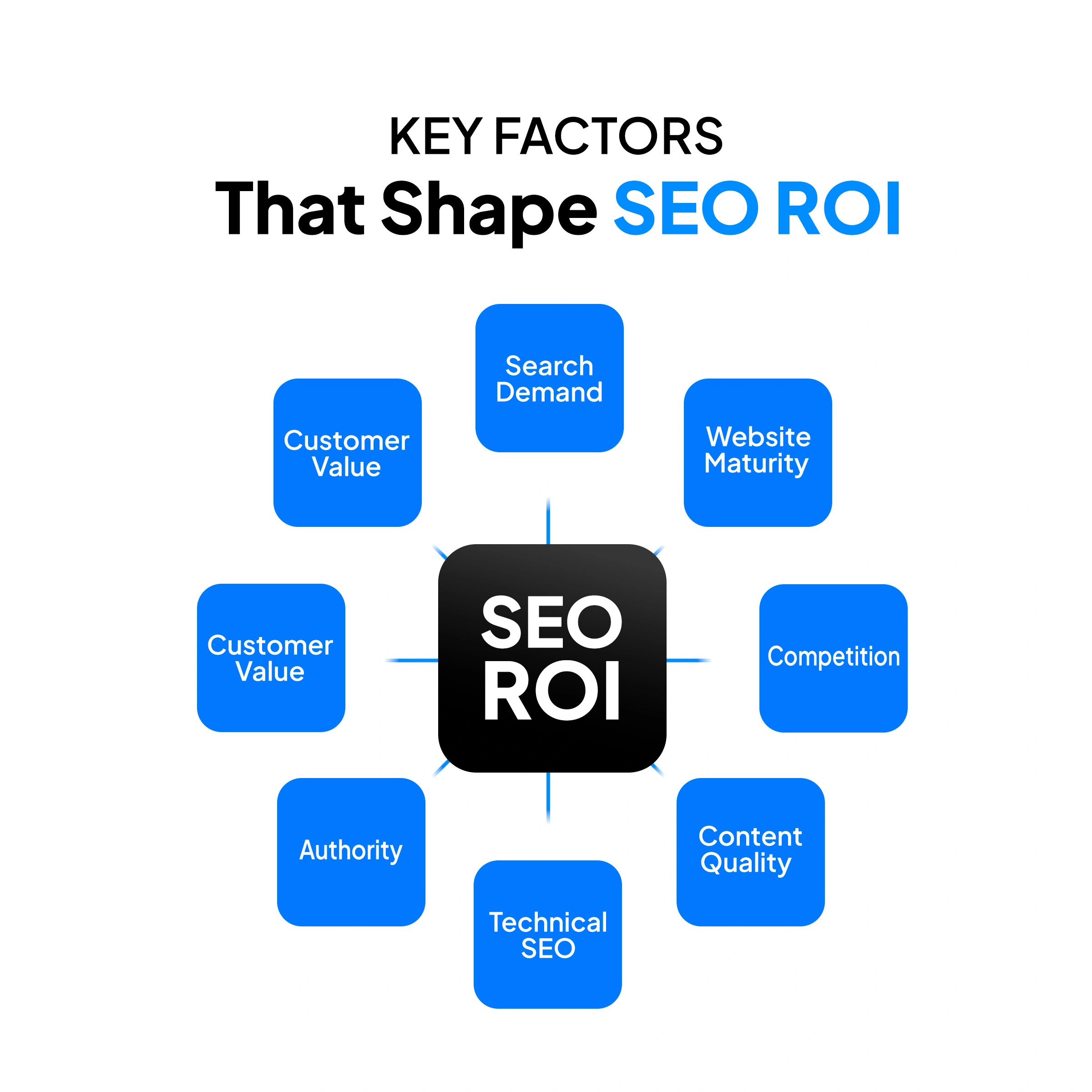
Several variables influence what a business can realistically achieve.
- Market and Competition
Highly competitive industries normally require more investment. A business competing for valuable finance, legal, SaaS, or healthcare searches may need stronger content, technical work, and authority than a business targeting a small niche.
- Website Maturity
An established site may already have rankings, backlinks, indexed content, and brand recognition. A new website generally has more groundwork to complete before meaningful organic search performance appears.
- Search Demand
SEO cannot create search volume where there is little demand. Businesses should understand whether potential customers actively search for their products, problems, services, or categories.
- Content Quality
The content must be written according to the search intent, clearly address users’ queries, showcase expertise, and provide enough insights for visitors to satisfy their requirements.
- Technical SEO
Technical issues such as indexing, crawlability, architecture, and linking can negatively impact performance. They can limit the user’s return to the website despite having a strong content foundation.
- Backlinks and Authority
Competitive pages often need authority from relevant external sources. Choose a link building agency that focuses on capturing the relevant, editorial opportunities rather than link volume alone.
- Conversion Rate
A higher conversion rate can increase SEO revenue without requiring the same increase in traffic. Moving a service page from a 2% conversion rate to 3% represents a 50% increase in conversions from the same number of visitors.
- Customer Value
A business selling a $50 product will calculate SEO economics differently from an enterprise company selling $50,000 contracts. Average order value, lead value, margin, retention, and CLV all influence SEO revenue calculation.
Leading vs. Lagging SEO KPIs
Not every SEO result appears at the same time. Leading indicators show whether SEO activity is beginning to move in the right direction. Examples include:
- Search impressions
- Keyword visibility
- Indexed pages
- Click-through rate
- Non-branded rankings
- Relevant referring domains
Lagging indicators show the final business result. These include:
- Qualified leads
- Sales
- Revenue
- Profit
- Customer acquisition cost
- Customer lifetime value
Understanding this difference prevents companies from judging long-term SEO solely through short reporting windows.
How to Calculate the Potential ROI of SEO and See If It Is Worth It?
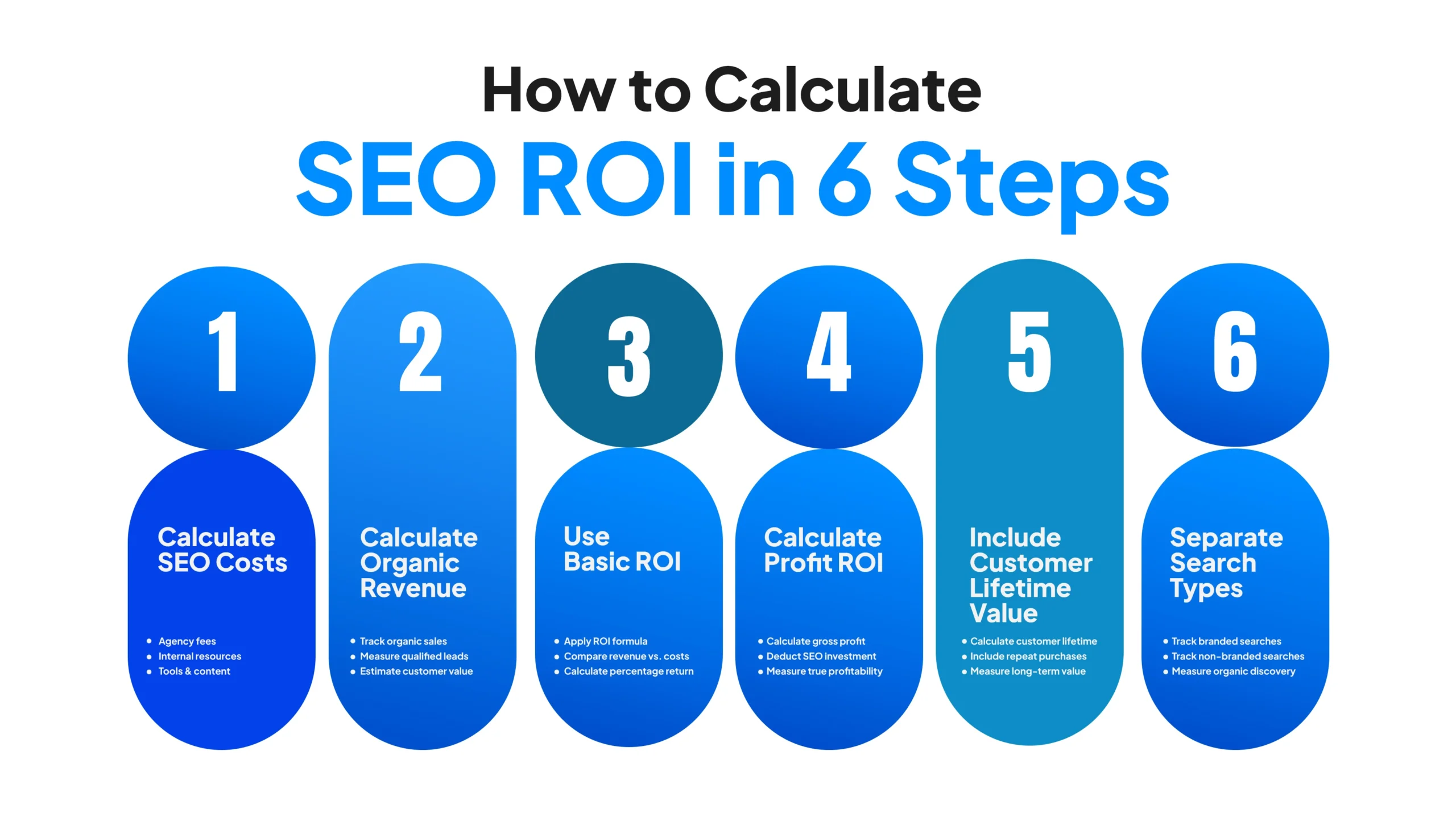
Calculating roi seo performance requires more than putting two numbers into a formula. A better approach is to build the calculation step by step.
Step 1: Calculate Your Total SEO Cost
Include every meaningful SEO expense. This may include:
- Agency retainers
- Internal employee time
- SEO software
- Content writing
- Editing and design
- Development
- Technical SEO
- Digital PR
- Link building services
- Reporting platforms
- Consultancy fees
Step 2: Calculate Organic Revenue
For ecommerce, revenue can often be connected directly with online purchases. For B2B businesses, use:
Organic Leads × Close Rate × Average Customer Value = Estimated SEO Revenue
Suppose SEO produces 100 qualified leads. If 20% become customers and an average customer is worth $5,000:
100 × 20% × $5,000 = $100,000 estimated organic revenue
Step 3: Use the Basic SEO ROI Formula
If SEO costs were $25,000: ($100,000 − $25,000) ÷ $25,000 × 100 = 300% SEO ROI
Step 4: Use a More Advanced Profit-Based Calculation
Revenue does not always equal profit. For companies with significant fulfilment costs, a more useful calculation is:
SEO ROI = (Organic Gross Profit − SEO Investment) ÷ SEO Investment × 100
This prevents high revenue with low margins from creating an unrealistic picture of profitability.
Step 5: Include CLV Where Relevant
Suppose the first purchase is worth $500, but the average customer generates $2,000 over their full relationship with the company. Using only the initial transaction can undervalue organic customer acquisition.
Step 6: Separate Branded and Non-Branded Searches
Branded searches often come from people who already know the company. Non-branded searches can provide a clearer view of discovery.
Google Search Console now offers a branded-query filter designed to distinguish branded from non-branded query performance, which can make this analysis more practical.
SEO Attribution: How to Give SEO Credit for Revenue?
SEO rarely works in isolation. A buyer might discover a company through organic search, return through LinkedIn, open an email, click a paid ad, and then convert directly. So which channel receives credit? This is the challenge of revenue attribution.
- First-Click Attribution
The first interaction receives the conversion credit. This can help businesses understand which channel originally introduced the customer.
- Last-Click Attribution
The final interaction receives the credit. It is simple but can understate channels that influenced the customer earlier.
- Linear Attribution
Credit is distributed more evenly across multiple recorded interactions.
- Position-Based Attribution
More credit is assigned to selected points in the customer journey, commonly the first and final interaction.
- Multi-Touch Attribution
Credit is distributed across several interactions based on the broader customer journey. Modern GA4 attribution reporting can compare how different attribution approaches affect conversion credit, while data-driven attribution evaluates converting and non-converting paths.
Types of SEO Spending That Influence ROI
SEO spending can broadly be divided into two groups.
Strategic and Operational Spending
This includes:
- SEO retainers
- Internal salaries
- Strategy
- Research
- Software
- White-label SEO Tool costs
- White-label reporting
- Account management
These costs keep the SEO operation running.
Execution Spending
This includes:
- Content
- Development
- Technical fixes
- Digital PR
- Link building services
- Landing page improvements
- Outreach
Both types support the same SEO strategy, but separating them helps businesses understand where their money is being used and which activities need more investment.
How to Measure SEO ROI: 5 Practical Ways
- Organic Revenue
Track sales generated through organic visitors. This is usually the cleanest method for ecommerce businesses with reliable transaction tracking.
- Lead Value
Calculate the value of organic leads based on historical conversion data.
Lead Value = Close Rate × Average Customer Value
- Traffic Value
Estimate how much similar traffic might cost through paid search. This is useful as a supporting metric, but it should not be reported as actual revenue.
- Customer Lifetime Value
Track how valuable customers remain after the initial purchase. This is particularly useful for SaaS, subscription businesses, repeat-purchase ecommerce, and long-term B2B relationships.
- Individual SEO Initiatives
Measure major projects separately where possible. For example, monitor the results of a content refresh, technical migration, product-category optimization, or authority campaign against its original objective.
Why CLV Matters for SEO ROI?
Customer lifetime value can significantly change how a company understands SEO profitability.
Imagine Channel A generates 100 customers worth $500 each and Channel B generates 100 customers whose first purchase is only $300. However, those customers eventually spend $2,000 each.
Looking only at immediate revenue would make Channel A appear stronger. CLV shows the longer financial relationship.
For businesses with repeat purchases or long contracts, this can make the ROI of SEO substantially more accurate.
How to Forecast SEO ROI From Traffic Numbers?
An enterprise SEO ROI calculator or internal forecast can use a simple model:
Search Demand × Expected CTR = Potential Organic Visits
Then:
Visits × Conversion Rate = Expected Conversions
Then:
Conversions × Customer Value = Potential Revenue
Suppose relevant searches total 10,000 per month.
At an estimated 8% CTR:
10,000 × 8% = 800 visits
At a 3% conversion rate:
800 × 3% = 24 conversions
If each conversion is worth $1,500:
24 × $1,500 = $36,000 potential revenue
If the SEO investment is $8,000:
($36,000 − $8,000) ÷ $8,000 × 100 = 350% projected ROI
Forecasts should include conservative, expected, and stronger-performance scenarios rather than one promised number.
Using Google Analytics to Calculate SEO ROI
GA4 is one of the most useful tools for connecting organic traffic with business actions. First, configure important events or conversions such as:
- Purchases
- Demo requests
- Form submissions
- Trial registrations
- Calls
- Appointment bookings
Businesses can connect analytics with CRM data to follow the journey from organic search performance. Search Console and GA4 can also be used together to compare search discovery with onsite behaviour. Google recommends combining the two for a more complete view of SEO performance.
Measuring SEO ROI in the AI Era
Businesses can follow the three-Layer Measurement Model for AI Search ROI
- Visibility
Measure whether your company, products, services, or pages appear across relevant AI search experiences. For Google specifically, Search Console’s generative AI reporting provides a direct source of visibility information.
- Traffic Isolation
Measure identifiable AI referrals where available. Also review branded search growth, direct visits, landing-page behaviour, and other signals that may indicate AI-assisted discovery.
- Pipeline and Revenue Attribution
Connect AI-influenced visitors and leads with CRM data.
Tips to Improve Your SEO ROI
- Prioritize Commercial Intent
High-volume keywords are not automatically valuable. Focus more resources on searches that have a realistic path to a product, service, lead, or purchase.
- Improve Conversion Rates
More traffic is not always necessary. Improving the conversion rate of existing landing pages can increase revenue from the traffic you already have.
- Refresh Pages With Existing Visibility
Pages already ranking near stronger positions may offer faster opportunities than creating everything from scratch. Update useful information, improve internal linking, and strengthen authority where appropriate.
- Fix Technical Problems
Indexation, crawlability, duplicate content, weak architecture, and poor performance can reduce the return from other SEO investments.
- Build Relevant Authority
Use link building services strategically. Links should support important pages and competitive opportunities rather than exist only to increase a backlink count.
- Connect Marketing and Sales Data
A growing number of leads means little if they are poor quality. CRM feedback helps SEO teams identify which organic leads become real opportunities.
- Review SEO Spending Regularly
Compare spending with outcomes. Move resources toward the activities that consistently contribute to qualified demand and shorten the payback period.
What Is the Average SEO ROI?
Average SEO ROI refers to benchmark performance across a group of businesses or campaigns. Benchmarks can help with planning, but they should never be treated as guaranteed returns. Customer value, competition, margins, conversion rate, search demand, and sales cycles can all change the result.
A SaaS business may achieve a higher return because one customer is worth thousands, while ecommerce often requires more sales volume. Your own SEO revenue, costs, and CLV remain the most useful benchmark.
| Industry | Indicative SEO ROI Range | Why Results Vary |
|---|---|---|
| B2B SaaS | 300%–800%+ | High LTV but longer sales cycles |
| Legal Services | 400%–1,000%+ | High lead value and strong competition |
| Healthcare | 250%–700% | Trust, compliance and search competition |
| Ecommerce | 150%–500% | Margins, AOV and conversion rates vary |
| Real Estate | 200%–600% | High lead value but strong local competition |
| Finance & Insurance | 300%–900%+ | High customer value and expensive acquisition |
| Local Businesses | 150%–500% | Results vary significantly by location and demand |
SEO ROI Statistics by Service Type
Different SEO activities produce returns at different speeds. Here are the SEO ROI statistics by service type:
| SEO Service | Main ROI Signal | Indicative Break-Even |
|---|---|---|
| Technical SEO | Better crawlability, visibility, and conversions | Around 6+ months in benchmark data |
| Strategic Content SEO | Qualified traffic, leads, and revenue | Often 9–15+ months |
| Ecommerce SEO | Organic product and category revenue | Often 12+ months |
| Enterprise SEO | Pipeline, visibility and revenue | Usually longer-term |
| Link Building | Rankings, authority and qualified traffic | Medium to long term |
| AI SEO | AI visibility and influenced demand | Emerging measurement area |
Do not use these figures as promises. Your historical data should remain the primary benchmark.
Why SEO ROI Reports Often Get It Wrong?
Most SEO ROI reports fail because the wrong data goes into it.
Many reports focus heavily on rankings, impressions, backlinks, and organic traffic. Those metrics show activity, but they do not explain whether SEO created qualified leads or revenue.
Attribution is another common problem. A customer may discover a business through Google, return through email, click a paid ad, and later convert directly. Giving the final channel all the credit can undervalue SEO. The opposite can also happen when every organic conversion is credited entirely to SEO.
A useful report should combine conversion tracking, CRM data, qualified leads, pipeline, revenue, and total SEO cost. This produces a clearer view of SEO profitability than traffic and ranking reports alone.
Dos and Don’ts of SEO ROI Reporting
Do:
- Track complete SEO costs
- Separate branded and non-branded traffic
- Connect analytics and CRM data
- Report qualified conversions
- Show revenue and pipeline
- Explain major changes
- Review CLV where relevant
Don’t:
- Treat traffic as revenue
- Count every lead equally
- Use rankings as the final KPI
- Ignore internal labour costs
- Promise forecast numbers
- Depend entirely on one attribution model
- Treat authority metrics as financial results
The Most Common SEO ROI Mistakes
The most frequent mistakes include:
- Ignoring internal SEO costs.
- Treating organic traffic as financial return.
- Counting unqualified leads.
- Ignoring customer lifetime value.
- Combining branded and non-branded searches.
- Measuring SEO over an unrealistically short period.
- Treating forecasts as guaranteed outcomes.
- Ignoring assisted conversions.
- Reporting backlink quantity without business context.
- Failing to connect analytics data with the CRM.
What a Good SEO ROI Report Should Include?
A useful report should help management decide what to do next. It must have:
- Organic traffic
- Non-branded visibility
- Important rankings
- Landing-page performance
- Conversion rate
- Qualified leads
- Pipeline
- Organic revenue
- Customer value
- Total SEO cost
- SEO profitability
- Payback period
- Major actions completed
- Recommended next steps
Agencies offering outsourced SEO can combine these metrics with White Label Reporting so clients receive business-focused reporting under the agency’s own brand. A reliable White Label SEO Tool can also reduce the manual work required to consolidate search, conversion, and client performance data.
Planning Marketing Expenses Using SEO ROI
Once a business understands its historical and projected SEO return, the data becomes useful for budget planning. Start by itemizing the cost of:
strategy, people, tools, technical work, content, authority building, conversion improvement, and reporting.
Then compare those costs with expected revenue, profit, CAC, CLV, and the expected payback period. SEO budgets should not be evaluated only on immediate monthly returns. Some improvements create assets that continue supporting acquisition after the original spend.
At the same time, “SEO compounds” should never become an excuse for spending indefinitely without measurable progress. Good budgeting combines short-term performance signals with long-term financial value.
SEO ROI vs. PPC ROI
SEO and PPC both target search demand, but their economics are different.
| Factor | SEO | PPC |
|---|---|---|
| Cost Model | Investment in organic visibility | Payment for advertising exposure/clicks |
| Speed | Usually slower | Usually faster |
| Continued Traffic After Spend | Can continue | Usually falls when spend stops |
| Asset Creation | Content and authority can retain value | Limited |
| Measurement | Often multi-touch | Usually easier to attribute |
| Compounding Potential | Higher | Lower |
| Main Formula | (SEO Revenue − SEO Cost) ÷ SEO Cost | (PPC Revenue − Ad Cost) ÷ Ad Cost |
How to Show ROI for Local SEO Clients?
Local SEO needs a slightly different measurement model because customers may call, book appointments, request directions, or visit a physical location. Useful local metrics include:
- Phone calls
- Appointment requests
- Quote requests
- Direction requests
- Qualified leads
- Local landing-page conversions
- Sales
- Revenue
The model becomes:
Local visibility → customer action → qualified lead → sale → revenue
For example, suppose local SEO generates 80 qualified calls. If 30% become customers:
80 × 30% = 24 customers
If each customer is worth $600:
24 × $600 = $14,400 revenue
With a $4,000 SEO investment:
($14,400 − $4,000) ÷ $4,000 × 100 = 260% estimated SEO ROI
Where possible, verify this with call tracking, CRM data, and actual sales records.
Takeaway
SEO ROI turns search performance into a business metric. Traffic, rankings, impressions, backlinks, and AI visibility can show progress, but they are not the outcome. Businesses should calculate their full SEO costs, track website conversions, separate branded and non-branded traffic, understand revenue attribution, measure CLV, and connect analytics with sales data.
FAQs
What is the ROI of SEO?
The ROI of SEO measures how much financial value a company generates from SEO compared with how much it spends. The standard formula is:
(SEO Revenue − SEO Cost) ÷ SEO Cost × 100
Is ROI Basically Profit?
Not exactly. Profit is the amount left after costs are deducted from revenue. ROI measures that gain relative to the amount invested and normally expresses the result as a percentage.
Is a 2% ROI Good?
That depends on the business, timeframe, risk, margin, and alternative investment opportunities. A positive ROI means the return exceeded the measured investment, but a 2% return may still be unattractive if other marketing channels produce much stronger returns.
How Does SEO ROI Compare With PPC ROI?
PPC generally produces results faster and is easier to connect with individual advertising costs. SEO usually takes longer, but content, rankings, and authority can continue producing value after the original investment. Businesses should compare both channels using revenue, profitability, CAC, CLV, and payback period rather than traffic alone.
How Do You Measure SEO ROI for a B2B Business?
Track organic leads through analytics and your CRM. Measure how many become qualified opportunities and customers, then connect those customers with actual revenue. For open opportunities, historical close rate and average customer value can be used to estimate SEO revenue until real sales data becomes available.
3 thoughts on “SEO ROI: How to Measure, Calculate, and Improve Your SEO Return”
Comments are closed.