Justifying the financial value of a backlink could be hard. A business may report acquiring 20 new referring domains with SEO activities in progress. However, highlighting the output generated from that is not simple!
Here comes Link Building ROI into the picture!
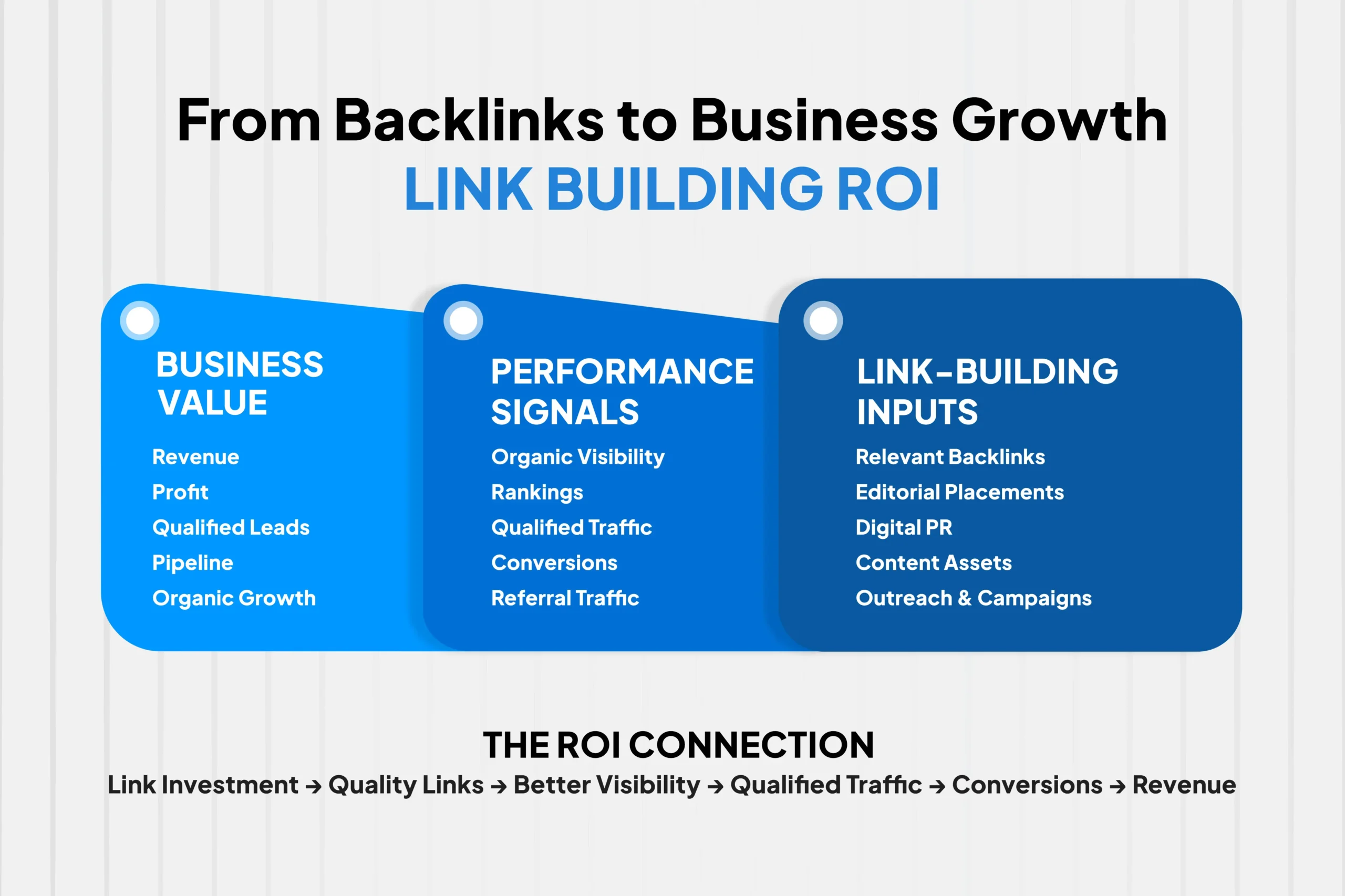
Link Building ROI connects money spent on acquiring relevant, authoritative links with measurable outcomes such as organic visibility, qualified traffic, conversions, pipeline, and revenue, and showcase to the business.
This guide explains what is Link Building ROI, and how businesses can calculate and measure it before increasing their link-building budget.
What Is Link Building ROI?
Link Building ROI helps to justify whether the budget allotted for link building is able to produce expected outcomes or not.
The expected results could be in the form of better rankings, qualified organic traffic, referrals, conversions, sales, or customer revenue over time.
While Link Building ROI correlates with SEO ROI, the term is a bit narrower. Here is how!
| Metric | What It Measures | Typical Costs Included | Typical Return |
|---|---|---|---|
| Link Building ROI | Return attributable to backlink acquisition and related authority-building activity | Outreach, PR, content assets, people, tools and campaign costs | Incremental traffic, leads, revenue and value influenced by acquired links |
| SEO ROI | Return generated by the complete SEO program | Technical SEO, content, links, tools, strategy, development and personnel | Total organic-search revenue, profit, pipeline and customer value |
Why Link Building ROI Matters to Businesses?
Link building can consume a substantial part of an SEO budget. When the investment is significant, measuring only links acquired is not sufficient. Tracking Link Building ROI helps a business determine:
- Whether link acquisition is improving commercially important pages;
- Which campaigns produce the strongest return;
- Whether the cost per meaningful link is sustainable;
- Whether referral and organic traffic are converting;
- Whether links are influencing revenue rather than only authority metrics;
- Which assets deserve continued promotion; and
- Whether the budget should= be increased, reduced, or redirected.
ROI analysis also prevents a common reporting problem: treating DR, DA, backlink volume, or keyword movements as the final objective. These are useful diagnostic metrics, but none represents revenue by itself.
Why Does It Take So Long to See Results?
A link can go live today without creating measurable revenue tomorrow.
Google first needs to discover or recrawl the linking page, process the link, and incorporate relevant signals into its systems. Ranking is then determined using many signals. Google explicitly notes that changes affecting search performance can sometimes appear quickly but may also require several weeks or months before their effects become clear.
Several additional delays occur after that:
- Ranking movement takes time- a newly strengthened page may need to move through multiple SERP positions before the improvement produces a material increase in clicks.
- Traffic comes after visibility- higher positions need sufficient search demand and attractive search snippets to translate into visitors.
- Conversions come after traffic- ecommerce may generate revenue relatively quickly, while an enterprise B2B lead may remain in the sales pipeline for months.
- Link impact is not isolated- content updates, technical changes, competitor activity, search demand, and algorithm changes can affect the same page simultaneously.
Therefore, businesses should start tracking link-building performance immediately, but avoid making a final financial judgment from only a few weeks of data.
How to Calculate Link Building ROI?
A useful Link Building ROI calculation requires more than link count and campaign spend. Here is what to do:
Collect a pre-campaign baseline for the target pages. This includes the organic clicks, impressions, rankings, conversions, revenue, referring domains, and relevant search demand.
Track the links acquired, total investment, changes in organic and referral performance, conversion value, and—in lead-generation businesses.
Compare against a relevant historical period or a group of similar pages that did not receive the same level of link support. It reduces the risk of assigning every organic improvement to backlinks.
What’s the Link-Building ROI Formula?
A basic revenue-based formula is:
Link Building ROI = [(Revenue Attributed to Link Building − Total Link-Building Cost) ÷ Total Link-Building Cost] × 100
Suppose a campaign costs $20,000 and the target pages generate an estimated $50,000 in incremental revenue during the measurement period.
[($50,000 − $20,000) ÷ $20,000] × 100 = 150% ROI
This means the campaign generated $1.50 in net revenue above the initial investment for every dollar spent. For a more financially rigorous analysis, use incremental gross profit or contribution margin instead of topline revenue.
Assume the same $50,000 in revenue carries a 60% contribution margin:
$50,000 × 60% = $30,000 contribution
The adjusted calculation becomes:
[($30,000 − $20,000) ÷ $20,000] × 100 = 50% ROI
This distinction is important because high revenue does not automatically mean high profitability.
A Cost-of-Investment Breakdown
The denominator must include the complete link-building investment, not only what was paid for outreach or placement.
| Cost | What to Include | Example |
|---|---|---|
| Tool Cost | Backlink intelligence, outreach, email discovery, monitoring and reporting platforms | $600/month |
| People Cost | Internal SEO specialists, PR staff, outreach teams, freelancers or agency management | $4,000/month |
| Content Cost | Research, surveys, reports, statistics pages, graphics, guest contributions and linkable assets | $3,000/month |
| Link/Campaign Cost | Agency fees, publisher-related campaign expenditure or other acquisition costs | $6,000/month |
| Total | Full monthly investment | $13,600/month |
Tool expenditure should not be overlooked. Nor should internal employee time be treated as free.
There is also an important compliance issue around link cost. Google’s current spam policies classify buying or selling links for ranking manipulation as link spam, while compensated links should be appropriately qualified. A high-cost placement is therefore not automatically a high-value SEO link.
How to Measure Link Building ROI?
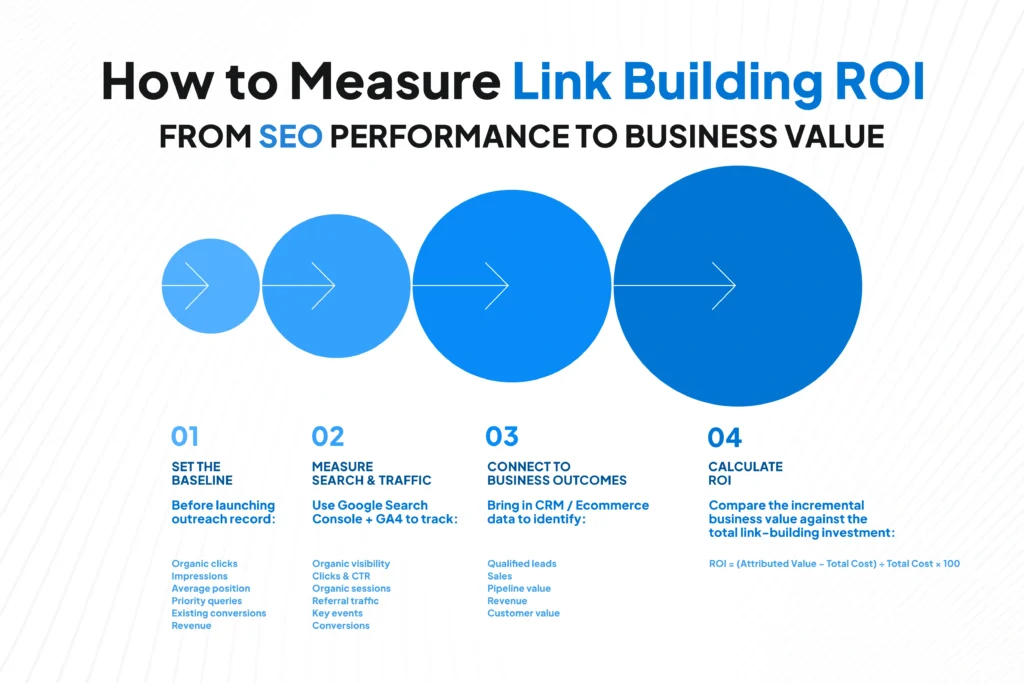
Measurement should begin before the first outreach email is sent because a clean baseline is required to understand what changed afterward.
The evaluation itself should be divided into short-term signals and long-term financial outcomes. Short-term measurement identifies whether the campaign is creating the conditions required for return. Long-term measurement determines whether those conditions eventually translate into business value.
How to Measure Link-Building ROI With GA4 and GSC?
Step 1: Set a baseline in GSC: Record clicks, impressions, CTR, average position, and priority queries for pages receiving backlinks.
Step 2: Track performance in GA4: Monitor organic sessions, referral traffic, key events, conversions, and revenue generated by supported landing pages.
Step 3: Connect GSC with GA4: Use Google Organic Search Queries and Google Organic Search Traffic reports to combine visibility and on-site behavior.
Step 4: Compare results over time: Measure changes against the pre-campaign baseline.
Step 5: Calculate ROI: Compare incremental conversion or revenue value with the total link-building investment.
A practical workflow is:
GSC: Did visibility and clicks improve?
↓
GA4: Did those additional visitors engage and convert?
↓
CRM/Ecommerce Data: Did those conversions create revenue?
↓
Cost Data: Did the financial value exceed the investment?
GA4 and GSC make measurement easier, but they do not prove that an individual backlink caused every ranking or revenue improvement. Link-building ROI should therefore be treated as incremental attribution, not artificial precision.
How to Forecast Link Building ROI Before You Start?
A business does not need to spend six months on links before asking whether the investment could make economic sense. Link Building ROI forecasting can begin before campaign launch by analysing the current site, SERPs, and expected economics.
Start with:
- Competitor referring-domain gaps for priority pages;
- Current keyword rankings;
- Realistic ranking opportunities;
- Monthly search demand;
- Expected CTR at improved positions;
- Existing organic conversion rate;
- Average conversion value;
- Customer lifetime value where relevant;
- current domain/page authority indicators;
- Content and technical quality;
- Projected cost per qualified link; and
- Estimated number of links required.
Consider a page generating 500 organic visits per month from a commercially important keyword cluster. Competitors ranking above it consistently have stronger relevant link profiles.
If analysis suggests that a campaign could increase the page to 1,200 monthly visits, the incremental 700 visits become the starting point for forecasting.
At a 2.5% conversion rate: 700 × 2.5% = 17.5 additional monthly conversions
If each conversion contributes $200: 17.5 × $200 = $3,500 monthly incremental value
Over 12 months: $3,500 × 12 = $42,000
If the campaign costs $18,000, that scenario can then be evaluated against the expected return.
How to Estimate ROI With Uncertainty?
Link Building ROI forecasting involves uncertainty because publishers, competitors, rankings, search demand, and conversion rates cannot be predicted precisely. A single estimate can therefore create an unrealistic expectation of future returns.
Using a Monte Carlo Simulation to Calculate Link Building ROI
A Monte Carlo simulation addresses this uncertainty by testing thousands of possible outcomes using realistic value ranges rather than fixed assumptions.
For example, instead of assuming a campaign needs exactly 18 links and will increase traffic by 40%, marketers can model ranges for links acquired, cost per link, traffic growth, conversion rate, and revenue. This produces a probability-based ROI forecast for better investment decisions.
What Are the Most Common Link Building Investment Mistakes?
Poor Link Building ROI often starts before the campaign launches. Here are the most common investment mistakes:
- Buying quantity instead of relevance: A large number of weak links may look impressive in a spreadsheet while adding little competitive value. Google continues to distinguish between useful editorial signals and manipulative link schemes.
- Using DR or DA as the only quality filter: These are third-party authority metrics, not Google ranking scores. Ahrefs notes that DR and DA are widely used by SEOs to assess authority, but they remain provider-specific metrics.
- Building links to the wrong pages: Strengthening a low-demand article that has no connection to conversions may produce less business value than supporting a commercial page or a strategic content asset.
- Ignoring content quality: Links cannot permanently compensate for a page that fails to satisfy search intent. Google’s ranking systems evaluate many signals, and its current guidance continues to prioritize helpful, reliable, people-first content.
- Ignoring internal costs: Outreach salaries, PR resources, writers, designers and software should be included in the investment.
- Expecting immediate revenue: Judging a long-term authority program after a few weeks can cause businesses to cancel promising work before sufficient data exists.
- Ignoring link risk: Cheap, scaled link schemes can create compliance risk rather than sustainable value. These are black hat SEO tactics, and a single penalty can wipe out the return the links were bought to deliver.
Avoiding these mistakes makes campaign economics clearer and directs budget toward links that have a realistic path to business impact.
Why Is Link Building ROI So Difficult to Measure?
Link Building ROI is usually harder to isolate than overall SEO ROI because link building is only one component of organic performance. Overall SEO ROI is easier to measure, and an SEO ROI calculator gives you that broader number to judge link building’s share against.
Several problems make exact attribution difficult:
- Google uses many ranking signals, making it impossible to assign a precise ranking percentage to one backlink.
- The effect of a link may not appear immediately.
- Multiple links may influence the same page at different times.
- Content updates can occur alongside link acquisition.
- Competitors continue changing their own content and backlink profiles.
- Search demand can rise or fall independently of SEO activity.
- Algorithm and SERP changes can alter CTR or rankings.
- Some links create valuable referral traffic without creating an obvious ranking change.
- Some links strengthen the broader authority or discoverability of a content ecosystem rather than one conversion page.
- Long B2B sales cycles separate the original organic visit from closed revenue.
The objective should therefore be decision-grade measurement, not an unsupported claim that every dollar of organic revenue came from a particular backlink.
Top Link-Building Strategies for Long-Term ROI
The strongest link-building strategies focus on earning relevant editorial links that have reasons to exist beyond manipulating rankings. This includes:
- Digital PR
Build research, expert commentary, industry analysis, or newsworthy campaigns that journalists have a legitimate reason to cite. Digital PR can generate links from authoritative publications while also increasing brand exposure. Ahrefs identifies digital PR and data journalism among its approaches for earning high-quality backlinks.
- Original Research and Data Assets
Surveys, proprietary datasets, benchmarks, calculators, and statistics pages can become linkable assets that continue attracting citations after the initial campaign. This changes the economics because one content investment can potentially generate links repeatedly rather than requiring a separate outreach cost for every acquisition.
- Relationship-Based Outreach
Build relationships with relevant publishers, journalists, industry experts, and complementary businesses before asking for links. Relationship-based campaigns may take longer initially but can reduce dependence on transactional outreach and create recurring editorial opportunities. Current link-building research highlights relationships as a way to support more sustainable acquisition.
- Unlinked Brand Mention Reclamation
Find relevant articles that already mention the company, product, research, or executives without linking to the source. Because the publisher already recognizes the brand, asking for an appropriate citation can require less persuasion than cold link outreach.
- Broken-Link and Resource Replacement
Identify authoritative pages linking to resources that no longer exist, create a genuinely useful replacement, and contact relevant publishers. The strategy works because it solves an existing problem for the publisher rather than asking for a link without providing value.
- Selective Expert Contributions
Contribute genuinely useful expert content to relevant industry publications when the editorial opportunity makes sense. Avoid scaling low-quality guest posts simply to manufacture links.
The Compounding Effect: How Link Building ROI Grows Over Time
Link Building ROI can increase over time because a quality backlink may continue supporting visibility long after the initial campaign ends. Stronger authority can improve rankings, attract organic traffic, generate conversions, and increase revenue without requiring the same acquisition cost again. The effect can compound further when higher-ranking content gains greater exposure and earns additional natural citations.
Quality Links → Better Visibility → More Traffic → More Citations → Stronger Authority → Higher ROI
This compounding effect depends on relevant editorial links, digital PR, original research, useful content, and credible industry placements, rather than simply acquiring a higher volume of backlinks.
Conclusion
Link Building ROI helps businesses evaluate backlink acquisition as an investment rather than a simple SEO activity. Effective measurement connects total campaign costs with outcomes such as qualified traffic, conversions, pipeline, and revenue.
Metrics like rankings, referring domains, impressions, and clicks remain useful indicators, but they should support, not replace, financial measurement. Because link impact develops gradually, businesses should combine short-term KPIs, long-term revenue tracking, and realistic forecasting.
Ultimately, sustainable returns depend more on link quality, relevance, and commercial alignment than backlink volume. Measuring these factors consistently helps businesses decide where to invest, optimize campaigns, and scale profitable authority-building efforts.
FAQs
How much does link building typically cost?
Link-building costs vary by industry, publisher quality, content requirements, outreach method, and campaign scale. Research suggests high-quality backlinks can cost several hundred dollars each, with premium placements costing more. Businesses should calculate total investment across tools, people, content, and campaign costs, not only the price per backlink.
Does link building still work?
Yes. Quality link building remains relevant because links continue to help search engines understand authority, relevance, and relationships between pages. However, effectiveness depends on earning relevant, editorially credible backlinks. Manipulative or low-quality links may provide little value and can create unnecessary SEO risk.
Is link building still worth the investment?
Yes, when a website has strong content, technical foundations, search demand, and an identifiable authority gap. Link building can support rankings, referral traffic, and organic revenue. Its value should be assessed through qualified leads, incremental revenue, pipeline contribution, and long-term organic growth, rather than backlink numbers alone.
What is the difference between Link Building ROI and link-building KPIs?
Link-building KPIs measure campaign performance through metrics such as referring domains, rankings, response rates, referral traffic, and cost per link. Link Building ROI measures financial return relative to total investment. KPIs show whether activities are progressing, while ROI determines whether those activities ultimately generate sufficient business value.
Does a higher number of backlinks mean higher ROI?
No. More backlinks do not automatically produce higher link-building ROI. Relevance, authority, placement quality, target-page value, and traffic potential matter more than volume alone. A smaller number of credible editorial links supporting commercially important pages can generate greater rankings, qualified traffic, and revenue than hundreds of weak backlinks.
3 thoughts on “Link Building ROI: From Backlinks to Business Growth”
Comments are closed.