
An enterprise website can hold hundreds of pages across multiple units, so link acquisition cannot operate like a small SEO campaign. A few people sending outreach from a spreadsheet is not enough. More stakeholders, more brand considerations, and far more risk if a campaign turns manipulative. Here, enterprise link building comes into the picture!
It creates a repeatable system that earns the relevant mentions from credible sources. This guide explains how enterprises can help businesses to build authority while protecting rankings and brand reputation. If you are new to ethical acquisition and want to know how to build high-quality white-hat backlinks, do not miss what’s coming next.
What Is Enterprise Link Building?
Enterprise link building is the process of earning relevant, trustworthy backlinks for a large organization while accounting for the scale, complexity, governance, and commercial exposure of the business.
The underlying principle is straightforward. Another website links to a page because the publisher considers the information useful, relevant, credible, or worth referencing.
What changes at the enterprise level is the environment around that link. A backlink campaign therefore needs more than prospect lists and outreach templates. It requires governance, prioritization, documentation, quality control, monitoring, and reporting.
Characteristics of a Scalable Enterprise Link Building Strategy
A program that scales without risk shares a consistent set of characteristics. Use these as a framework for evaluating any enterprise link building strategy before it is funded.
- Repeatable. The program runs as a documented system, not a series of one-off campaigns that restart each quarter.
- White-hat. Every tactic aligns with Google Search Essentials and can be defended to legal and leadership.
- Data-driven. Opportunities are scored on authority, relevance, effort, brand fit, and business value rather than chosen by instinct.
- Relationship-focused. Publisher and journalist relationships are treated as strategic assets that compound over time.
- Automated where appropriate. Automation handles prospecting, tracking, and reporting, while humans handle judgment and outreach.
- Editorial-first. Placements are earned through genuine editorial merit, not paid ranking value.
- Measurable. Every campaign connects to metrics that hold up in a boardroom.
- Sustainable. The assets and relationships continue to generate value long after a campaign ends.
Enterprise Link Building vs. Traditional Link Building: How They Are Different?
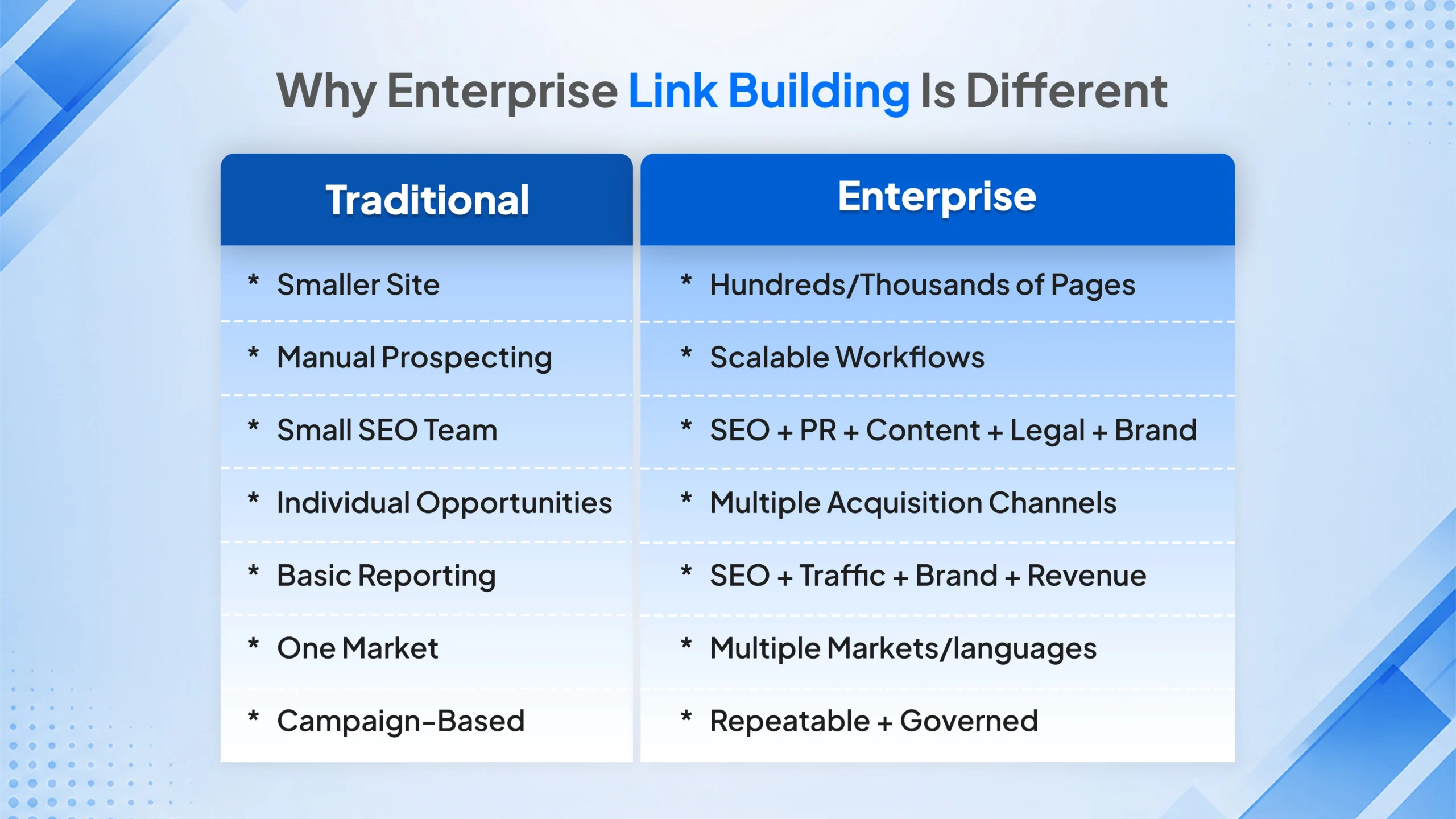
| Factor | Traditional Link Building | Enterprise Link Building |
|---|---|---|
| Website Scale | Smaller websites with fewer pages | Large websites with thousands or millions of URLs |
| Prospecting | Often handled manually | Uses structured, scalable prospecting workflows |
| Outreach | Personalized outreach to a smaller prospect list | Segmented outreach across markets, teams, and publisher groups |
| Quality Control | Managed by a small SEO team | Requires defined standards, reviews, and governance |
| Stakeholders | Usually SEO or marketing | SEO, PR, content, legal, brand, product, and regional teams |
| Link Acquisition | Focuses on individual opportunities | Combines outreach, link earning, PR, partnerships, research, and content |
| Content Strategy | Individual linkable articles or resources | Large-scale research, tools, data assets, content hubs, and thought leadership |
| Technology | Basic SEO and outreach tools | Integrated enterprise SEO tools, CRM, reporting, automation, and AI assistance |
| Risk Management | Relatively straightforward | Greater focus on brand reputation, compliance, and Google link spam risks |
| International SEO | Often limited to one market | May require country-specific, regional, and multilingual campaigns |
| Measurement | Backlinks, referring domains, rankings | Links, authority, organic visibility, referral traffic, brand mentions, pipeline, and revenue |
| Workflow | Campaign-based | Repeatable, documented, and governed process |
| Primary Goal | Earn relevant backlinks | Build scalable authority while protecting long-term organic visibility and brand reputation. |
Why Enterprise Link Building Requires a Different Strategy?
Scale changes the economics of SEO. A website with 200 important pages can be managed very differently from one with 500,000 URLs. The same applies to stakeholders, markets, content production, and brand risk.
1. Website Scale
Enterprise sites often have multiple layers of architecture. A single domain may contain product pages, category pages, research hubs, support content, regional folders, campaign landing pages, and legacy URLs.
That creates an important question: Where should external authority go?
Sending every earned link to the homepage is rarely the best answer. Some campaigns should support research content. Others may strengthen category hubs, product resources, local pages, or pages sitting at the center of an important topic cluster.
The external acquisition strategy should therefore connect with the site’s internal linking architecture.
2. Multiple Stakeholders
An enterprise campaign may involve SEO, content, PR, brand, product marketing, communications, legal, regional teams, and senior executives. Without a defined workflow, even a good campaign can stall. A mature program establishes responsibilities before outreach begins. This includes:
- SEO identifies strategic opportunities.
- Content develops useful resources.
- PR manages media relationships.
- Subject-matter experts validate claims.
- Legal reviews sensitive material where necessary.
- Regional teams adapt campaigns for local markets.
- Reporting teams connect activity with business outcomes.
3. Brand Reputation
For an enterprise, a backlink is also a public association. A major company appearing repeatedly on irrelevant, low-quality websites may create questions about its marketing practices even if the links never produce a measurable ranking problem.
That is why white-hat link building should be treated as part of brand protection as well as SEO. The strongest placement should make sense to three audiences at once:
- The reader
- The publisher
- The organization behind the website
If the only reason a link exists is to influence rankings, the campaign deserves another look.
Why Safe Link Building Matters?
The risk associated with manipulative acquisition extends beyond a possible search visibility problem. For an enterprise, the consequences can reach much further.
1. Google Spam Systems
Search engines have sophisticated systems for identifying patterns associated with manipulation. An enterprise should therefore avoid building a program around tactics that depend on staying ahead of detection. The safer approach is to build assets and relationships that have value independently of search engines.
2. Manual Actions
Some spam issues can result in manual action. Even when a site is not affected across its entire domain, investigating and correcting a serious problem can consume considerable internal resources.
3. Algorithmic Devaluation
A backlink does not automatically retain value simply because it exists. Search systems can reassess signals over time. This is one reason link quality matters more than a spreadsheet total.
4. Brand Damage
Poor placements can be visible to anyone. Therefore, businesses must evaluate their link profile as a part of the organization’s broader digital reputation.
5. Toxic Backlinks
Examine patterns, relevance, source quality, intent, and whether there is evidence of manipulative activity rather than treating every unfamiliar domain as an emergency. For a deeper explanation, see What is White-Label SEO?
15 Enterprise Link Building Strategies That Scale
1. Digital PR Campaigns
Digital PR can turn proprietary information, expert knowledge, and original stories into editorial coverage. For an enterprise, potential campaigns include:
- Industry surveys
- Consumer research
- Proprietary datasets
- Market trend reports
- Expert commentary
- Original statistics
- Annual reports
- Data visualizations
The key is to develop the story before thinking about the backlink. A journalist is unlikely to care that a company wants another referring domain. They may care that a new dataset reveals a meaningful shift in consumer behavior.
Best practice
Build a media list around the subject rather than the domain’s size. A smaller specialist publication may deliver greater relevance than a large general-interest website.
Common mistake
Launching a “digital PR campaign” that is essentially a product announcement with a few statistics added. If there is no genuine story, coverage becomes difficult to earn.
2. Publish Original Industry Research
Original research is particularly valuable because it can become a source that other publications reference. An enterprise may have access to:
- Customer surveys
- Anonymized usage data
- Industry benchmarks
- Transaction trends
- Product insights
- Regional statistics
- Expert interviews
A well-produced original research report can support several channels at once.
Explain the methodology. Identify the sample size where appropriate. Define the research period. Distinguish between findings and interpretation. A statistic becomes more useful when readers can understand where it came from.
3. Build Linkable Assets
Not every useful asset needs to be a 3,000-word article. Enterprise brands can develop:
- Calculators
- Templates
- Interactive tools
- Checklists
- Research databases
- Original datasets
- Industry benchmarks
- Visual explainers
- Planning resources
The strongest linkable assets solve a problem that publishers and readers already have. A calculator can help a journalist explain a cost. A benchmark can support a research article. A template can become a reference resource for an entire industry.
Maintain the asset
If a calculator relies on outdated assumptions or a benchmark has not been refreshed in three years, its value declines. Assign ownership, review important assets periodically, and update statistics when the underlying information changes. A resource that continues to be useful has a better chance of generating links over a longer period.
4. Thought Leadership Content
Enterprise brands already employ people with valuable expertise. The challenge is turning that knowledge into visible authority. Thought leadership can include:
- Executive interviews
- Expert commentary
- Conference presentations
- Industry predictions
- Research interpretation
- Podcasts
- Webinars
- Professional articles
The content should contain an actual point of view.
“Five trends to watch” is easy to produce. A well-supported explanation of why an industry trend is happening, what businesses are getting wrong, and what evidence supports that conclusion is more valuable.
Executive visibility can also support broader E-E-A-T signals by making expertise easier for readers to understand and verify. Google’s current guidance encourages clear evidence of expertise, trustworthy sourcing, and information that demonstrates real knowledge of the subject.
5. Strategic Partnerships
Partnerships can generate strong editorial opportunities because the relationship exists for reasons beyond SEO. Potential sources include:
- Technology partners
- Integration partners
- Universities
- Industry associations
- Suppliers
- Customers
- Research organizations
For example, a technology company launching an integration with another platform may naturally be mentioned on the partner’s integration page.
Do not create artificial partnerships solely to obtain links. Instead, look for existing relationships where useful information, documentation, case studies, research, or joint resources already have a legitimate place.
6. Resource Page Link Building
Resource pages can still provide useful opportunities when the page is genuinely curated and relevant. The process starts by identifying pages maintained by:
- Universities
- Industry bodies
- Professional organizations
- Specialist publishers
- Educational institutions
- Established experts
Instead of explaining why the company deserves a backlink, explain why the resource could help that page’s audience.
7. Competitor Backlink Gap Analysis
Competitor analysis should answer more than “Where are competitors getting links?” It should identify patterns of opportunity. Look for:
- Publications covering the category
- Industry associations
- Resource pages
- Journalists
- Research sources
- Partnership networks
- Content formats attracting citations
- Domains linking to multiple competitors
A link-intersect analysis can help identify sites that reference several competitors but have not yet mentioned the enterprise. The resulting list should then be prioritized.
8. Link Reclamation
Enterprise websites naturally accumulate lost opportunities. These may include:
- Broken backlinks
- Deleted pages
- Changed URLs
- Unlinked brand mentions
- Lost media placements
- Image credits
- Expired redirects
- Old product pages
Link reclamation works because the organization is not starting from zero. Someone has already mentioned the brand, referenced the resource, or linked to a previous URL.
If an established publication has mentioned the organization without linking to it, a polite request may be appropriate when the reference genuinely benefits readers.
9. Internal Link Equity Optimization
External links are only one part of authority management. Once a valuable page earns strong references, internal links help distribute that relevance across the site. An enterprise internal linking strategy may include:
- Topic clusters
- Content hubs
- Hub-and-spoke architecture
- Contextual links
- Breadcrumbs
- Category navigation
- Supporting resource pages
Consider an enterprise technology site with a highly authoritative research report. If that report has earned significant editorial attention, relevant internal links can connect it with deeper educational content, product categories, and supporting resources.
This creates a stronger relationship between external authority and commercially important sections of the website.
10. Content Marketing at Scale
Enterprise content production should operate as a system rather than a queue of disconnected articles. A useful structure can include:
Core topic → pillar resource → supporting articles → research → expert commentary → linkable assets
This creates depth around important subjects instead of publishing isolated pages simply to increase content volume. An enterprise editorial system should define:
- Priority topics
- Search demand
- Business relevance
- Existing content
- Content gaps
- Expert availability
- Refresh requirements
- Promotion opportunities
Google’s current guidance cautions against producing large volumes of content primarily to capture search traffic. It instead recommends creating material that provides original value and satisfies the audience. That makes content governance especially important for large organizations.
11. Reactive PR
Some of the strongest media opportunities have a short shelf life. Reactive PR allows an organization to respond to:
- Breaking industry news
- Regulatory developments
- Major market changes
- Search developments
- Product announcements
- Emerging trends
Maintain an approved expert list. Establish who can comment publicly. Prepare background information in advance. Make the approval route clear. When a journalist needs an expert within two hours, a six-stage approval process can mean the opportunity has already disappeared.
12. Local and International Link Building
A global website should not assume that one international campaign can serve every market. International link building works best when local relevance is built into the strategy. Consider:
- Regional publications
- Country-specific industry websites
- Local associations
- National research bodies
- Multilingual resources
- Regional experts
- Local events
13. Community and Industry Contributions
Authority is also built through participation. Experts can contribute to:
- Open-source projects
- Podcasts
- Webinars
- Professional associations
- Industry events
- Specialist communities
- Educational initiatives
14. AI-Assisted Outreach With Human Review
AI can make an enterprise outreach program more efficient, but it should not turn publisher relationships into automated transactions. Useful applications include:
- Prospect research
- Publication summaries
- Topic matching
- Contact organization
- CRM updates
- Initial email drafts
- Follow-up reminders
- Outreach classification
- Campaign reporting
The human reviewer should remain responsible for:
- Relevance
- Tone
- Accuracy
- Brand suitability
- Relationship history
- Editorial judgment
- Final approval
A message that says, “I loved your recent article about X” is not personalized if the sender has not actually considered what the article means for the proposed resource. Good personalization explains the connection.
15. Executive and Brand Entity Building
Search engines increasingly need to understand entities: organizations, people, products, subjects, and the relationships between them. For enterprises, entity SEO can therefore complement conventional link acquisition.
Consider how consistently the brand and its experts are represented across:
- Author profiles
- Executive biographies
- Conference pages
- Industry publications
- Company profiles
- Research reports
- Interviews
- Expert commentary
- Brand mentions
An enterprise should make it easy for readers and search systems to understand who the organization is, what it does, which subjects it has expertise in, and which people represent that expertise.
Enterprise Link Building Workflow
A scalable program needs a documented workflow.
A practical sequence is:
Research → Prospecting → Asset Creation → Outreach → Relationship Building → Monitoring → Reporting
1. Research
Identify priority subjects, pages, audiences, competitors, existing authority, and gaps.
2. Prospecting
Find publishers, organizations, experts, journalists, partners, and resources that are relevant to those subjects.
3. Asset Creation
Develop something worth referencing: research, a tool, a dataset, expert commentary, a guide, or another useful resource.
4. Outreach
Contact prospects with a specific reason for the conversation.
5. Relationship Building
Do not treat every publisher interaction as a one-time transaction. Maintain useful relationships between campaigns.
6. Monitoring
Track acquired links, lost placements, broken URLs, unlinked mentions, referral traffic, and significant changes in the backlink profile.
7. Reporting
Connect activity with SEO and business outcomes.
The workflow becomes more powerful when each stage informs the next campaign.
If original research consistently attracts high-quality coverage, invest further in research. If a certain publication category produces visibility but little relevant traffic, reassess its priority. If one content format repeatedly attracts citations, determine whether it can become a repeatable program.
Enterprise Link Building Tech Stack
Technology should solve operational problems rather than become a collection of subscriptions. A typical enterprise SEO tech stack may include several categories.
1. Backlink Analysis
Used to understand referring domains, competitor gaps, lost links, anchor patterns, and broader profile changes.
2. CRM
Maintains publisher and partner relationships, communication history, contact ownership, and campaign notes.
3. Outreach Platforms
Helps organize prospecting, communication, follow-ups, and campaign status.
4. PR Monitoring
Tracks brand mentions, journalist activity, industry conversations, and relevant news.
5. Content Planning
Connects topic research, editorial calendars, expert input, publishing schedules, and refresh cycles.
6. Internal Linking
Helps identify contextual linking opportunities and gaps across large content libraries.
7. Reporting Dashboards
Bring SEO, referral, brand, and commercial metrics into one reporting environment.
8. AI Assistance
Supports research, classification, summarization, drafting, and workflow management.
The principle is simple:
Automate the repetitive work. Keep the important decisions human.
How to Measure Enterprise Link Building Success?
The number of backlinks acquired is one metric. It should not be the entire measurement framework. A stronger link building ROI model combines authority, visibility, traffic, brand impact, and commercial outcomes.
1. Referring Domains
Track the number and quality of unique websites linking to the organization.
2. Link Quality
Evaluate relevance, editorial context, source credibility, placement, and potential referral value.
3. Topical Relevance
A relevant publication can be more strategically valuable than a larger but unrelated website.
4. Organic Visibility
Monitor changes in rankings, impressions, non-branded queries, and organic traffic around strategically important topics.
5. Referral Traffic
A backlink that sends qualified visitors can have value independent of its SEO contribution.
6. Brand Mentions
Track media references, expert citations, and broader recognition.
7. Revenue and Pipeline
Where attribution allows, connect link acquisition and digital PR campaigns with assisted conversions, qualified leads, pipeline, or revenue.
8. Media Placements
For PR-led programs, measure the quality and relevance of earned coverage rather than treating every mention equally. A useful reporting framework separates activity metrics from business outcomes.
Common Enterprise Link Building Mistakes
1. Buying Backlinks
Purchasing links specifically to manipulate organic rankings creates unnecessary risk. Google’s spam policies identify link spam and ranking manipulation as violations. Legitimate advertising, sponsorship, or commercial relationships are different and should be handled appropriately, including the relevant link attributes where applicable.
2. Over-Optimized Anchor Text
Using the same commercial keyword repeatedly can make an external profile look unnatural. Anchor text should reflect the context in which the publisher is linking. Editorial links do not need to be engineered around an exact-match phrase.
3. Scaling Poor Outreach
Increasing the number of emails does not automatically increase the number of quality placements. Poorly targeted outreach can damage relationships with publishers and make future campaigns harder.
4. Ignoring Internal Links
External authority needs a logical path through the site. A strong backlink pointing toward an isolated page may not deliver the same strategic value as one connected to a well-structured topic cluster.
5. Publishing Thin Assets
Calling something a “linkable asset” does not make it useful. If the page adds little beyond information already available elsewhere, publishers have limited reason to reference it.
6. Treating Link Building as a One-Time Project
Authority compounds through relationships, content, reputation, and repeated exposure. Pausing outreach after one campaign throws away the relationship capital created during that period.
7. Ignoring Link Maintenance
Links disappear. Pages move. Websites redesign. Publishers update old articles. Domains expire.
A mature program monitors these changes instead of assuming every acquired placement will remain forever.
8. Treating Every Unfamiliar Link as Toxic
Not every low-authority or irrelevant link requires immediate intervention. Enterprise teams should investigate patterns and context rather than reacting to isolated domains without evidence of a problem.
The Future of Enterprise Link Building: 2026 and Beyond
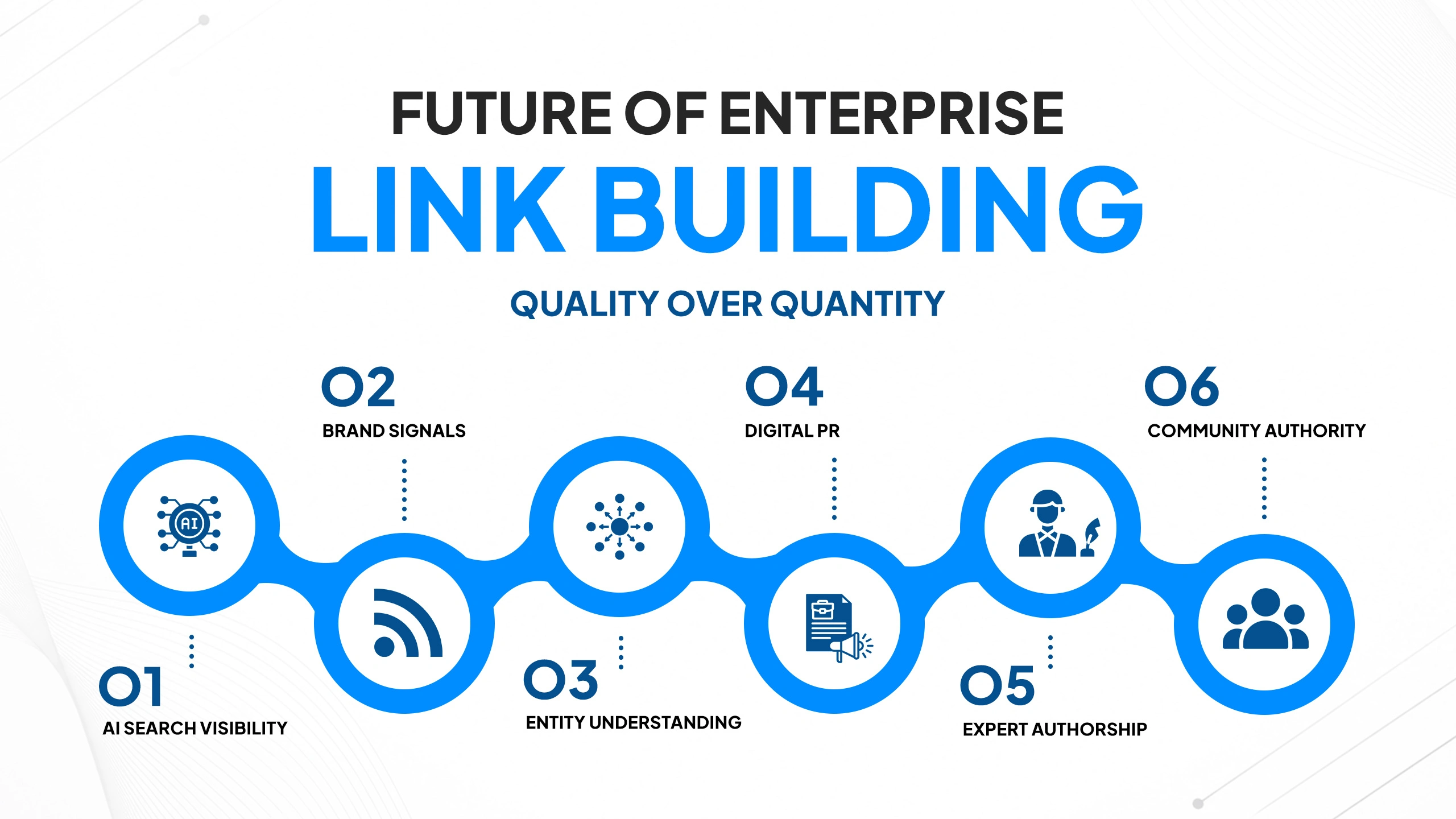
Search is becoming more complex, but the underlying principle has not changed.
Google’s current guidance continues to prioritize useful, original, people-first content. Its AI search guidance likewise recommends unique information that satisfies users rather than content produced primarily for search visibility. Several areas are likely to become increasingly important for enterprise organizations.
1. AI Search Visibility
AI Overviews and AI Mode are changing how users discover information. Google has also begun testing dedicated reporting for generative AI visibility in Search Console.
This creates another reason to publish information worth citing.
2. Brand Signals
Recognition across credible sources can help establish a stronger digital presence than isolated keyword-focused pages.
3. Entity Understanding
Search systems need to connect organizations with people, subjects, products, and expertise.
4. Digital PR
Original data and credible expert commentary can earn visibility across traditional media and newer search experiences.
5. Expert Authorship
Demonstrable expertise matters when organizations compete in subjects where trust is important.
6. Community Authority
Industry participation can create recognition that cannot be replicated through mass outreach.
7. Link Quality Over Quantity
A smaller collection of highly relevant editorial references can be strategically stronger than a large volume of weak placements.
The biggest change may therefore be philosophical.
Enterprises will need to stop asking:
“How can we get more links?”
And start asking:
“What can we publish, contribute, research, or explain that other people will genuinely want to reference?”
Enterprise Link Building Checklist
Before scaling a program, review these ten areas:
- Audit the backlink profile
- Analyze competitor opportunities
- Create original linkable assets
- Build a qualified outreach list
- Develop digital PR campaigns
- Monitor earned placements
- Reclaim lost links and unlinked mentions
- Track SEO and commercial KPIs
- Refresh important assets regularly
- Review anchor text and overall profile quality
For larger organizations, add three governance checks:
- Is every campaign assigned an owner?
- Are brand and compliance requirements documented?
- Is there a defined process for reviewing unusual or high-risk opportunities?
A simple quality test can also help:
Would we be comfortable showing this placement to our customers, leadership team, PR department, and SEO team?
If the answer is yes for the right reasons, the opportunity is probably worth considering.
Conclusion
Enterprise link building is not about collecting the highest number of backlinks. It is about building a reliable system that earns recognition from relevant, credible sources. Original research, digital PR, thought leadership, partnerships, valuable resources, link reclamation, and targeted outreach can create lasting authority when supported by clear governance and measurement. AI can improve prospecting, research, drafting, and workflow efficiency, but human judgment remains essential for accuracy, relevance, and brand protection. As search evolves, enterprises should focus on creating information that deserves to be referenced. The goal is simple: build links through genuine value, not artificial tactics, and turn SEO authority into sustainable growth.
FAQs
Can AI automate enterprise outreach?
Yes, AI can support enterprise outreach by handling prospect research, contact organization, publication analysis, CRM updates, personalization, and email drafting. However, human review remains essential for enterprise link building to verify relevance, accuracy, brand suitability, editorial context, and relationship quality.
How long does enterprise link building take?
The timeline for enterprise link building varies by strategy. Link reclamation and unlinked mentions can produce quicker opportunities, while digital PR, original research, and thought leadership take longer. Sustainable link building focuses on long-term authority growth rather than short-term backlink acquisition.
What is the safest enterprise link-building strategy?
The safest enterprise link-building strategy focuses on earned editorial links through original research, digital PR, useful resources, expert contributions, genuine partnerships, and link reclamation. These white-hat link-building methods create legitimate value for publishers and audiences while reducing reliance on manipulative acquisition tactics.
Should enterprises buy backlinks?
Enterprises should avoid buying backlinks specifically to manipulate search rankings. Paid backlinks created for ranking purposes can create unnecessary SEO risk. Instead, prioritize white-hat link building, editorial placements, digital PR, and genuine partnerships. See Google Penalties: The Hidden Cost of Black-Hat SEO for more context.
How often should enterprises audit backlinks?
Enterprises should continuously monitor their backlink profile, with detailed audits performed regularly. Monthly monitoring can identify lost links, broken destinations, and unusual changes, while quarterly reviews can assess link quality, referring domains, anchor distribution, competitor activity, and opportunities across international SEO markets.
1 thought on “Enterprise Link Building: Strategies That Scale Without Risk”
Comments are closed.