One of the most common questions we get on sales calls is, “What would you actually do on my website every month? Can’t you just do all of that at once?”
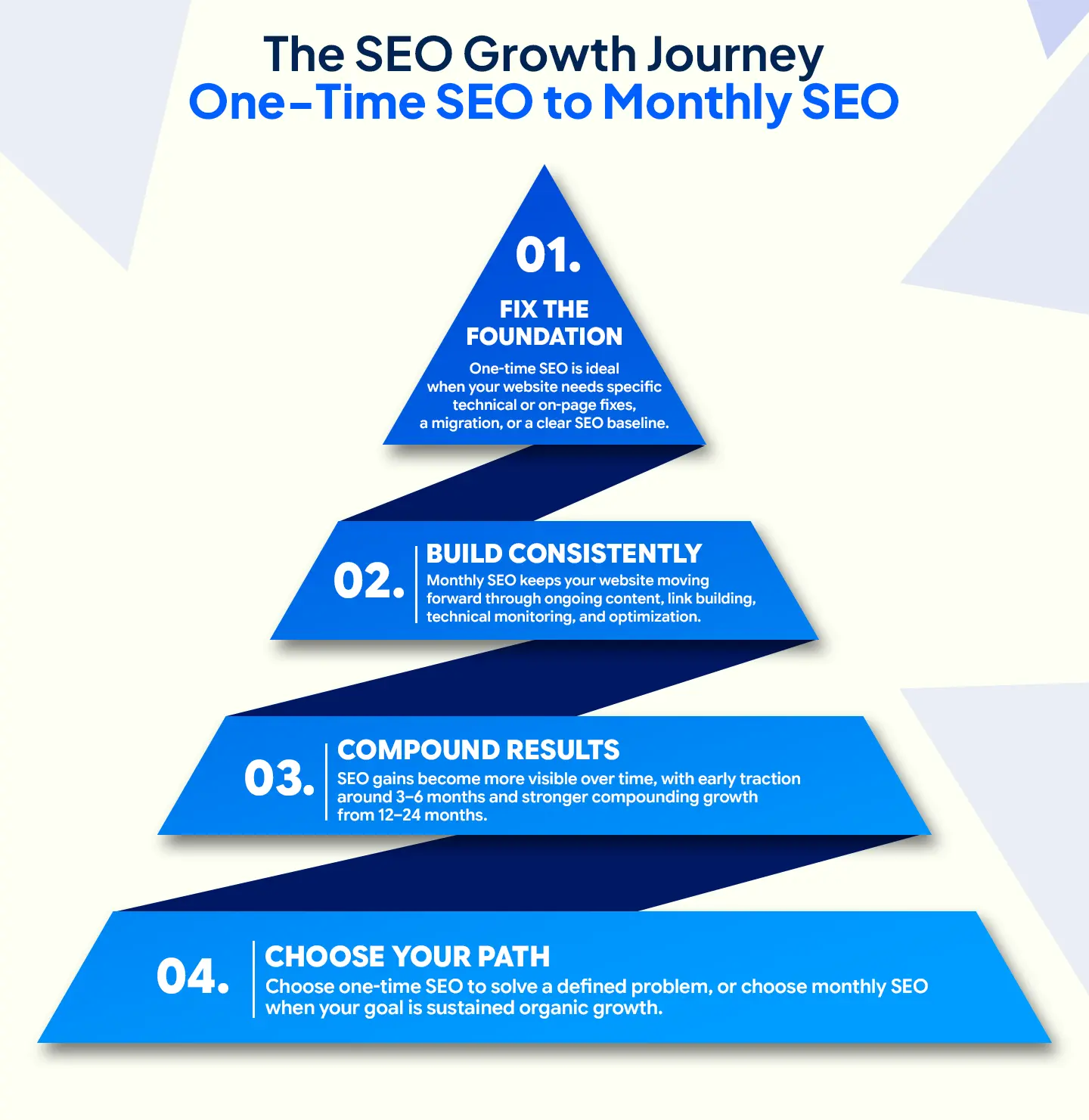
In this monthly SEO vs. one-time SEO debate, for long-term business growth, monthly SEO is usually the better fit because SEO needs ongoing optimization, content updates, link building, and monitoring. One-time SEO can fix the immediate issues and give you a strong starting point, but ongoing work gives you room to respond as your site, competitors, and search results change.
The difference becomes clearer when you look at what you’re paying for over time. Some SEO work can be completed once and left alone, while other work needs to keep moving to produce results.
Below, we break down what each model includes, how the costs add up over time, where one-time SEO makes sense, and what you can expect from each approach.
Key Takeaways
- Monthly SEO management builds compounding results. Most businesses see real movement between month three and month six, with the biggest gains showing up after month twelve.
- One-time SEO services solve a specific and immediate problem well. Like a broken site, a bad migration, etc.
- A monthly SEO retainer usually costs less over 12-24 months than repeating a one-time project every few months just to stay in place.
- The honest answer to “is monthly SEO worth it” depends on your timeline. For long-term growth, yes; for a single, isolated fix, one-time SEO can be the smarter buy.
What Is One-Time SEO?
One-time SEO, sometimes sold as a one-time SEO project or an SEO setup, is a fixed-scope engagement targeting small businesses, early-stage startups, and non-technical site owners. You pay once, get a defined list of deliverables, and the relationship ends when the invoice is settled. No retainer, no ongoing commitment, no surprises on your monthly statement.
Most one-time SEO services cover the same core ground. A technical audit, on-page optimization setup, fixing what’s actively broken, and sometimes a first round of link building to establish a baseline. It’s foundational work the kind that has to exist before anything else can perform.
People use the terms interchangeably, but worth separating here: a one-time SEO audit and a full one-time SEO project are not the same thing. An audit tells you what is wrong. A project fixes it. Some agencies sell the audit alone as a standalone deliverable; a full one-time package includes both the diagnosis and the fix.
Depending on what’s actually bothering the client, a one-time engagement can mean a log-file analysis to see what Google is really crawling instead of what the sitemap claims, a crawl budget audit on a larger site losing coverage to junk URLs, an orphan page audit, a check for canonical and noindex tags contradicting each other, a duplicate content audit (www versus non-www, stray URL parameters, that kind of thing), a look at URL structure and overall site architecture, or a competitor gap analysis to see exactly where ground is being lost.
Some clients ask for a schema audit and optimization pass instead, covering organization and article markup along with FAQ schema, which lost its SERP-rich result placement in late 2025 but still matters for how AI systems cite a page. Others want an AEO or GEO readiness check now that AI search is part of the picture, a straightforward HTTPS and security pass, or an hreflang review if the site runs across multiple regions.
One-Time Technical SEO Setup: What’s Actually Included
A proper one-time technical SEO setup usually covers:
- A full technical SEO audit: crawlability, indexation, site architecture, broken links, duplicate content
- URL structure and website architecture audit: reviewing site hierarchy and URL design
- Technical hygiene and site integrity: URL structure review, HTTPS and security pass, and hreflang setup for multi-region sites
- Structured data and search visibility: schema markup setup (organization, article, and FAQ schema for AI engine visibility) and competitor gap analysis
- AI search readiness: AEO (Answer Engine Optimization) and GEO (Generative Engine Optimization) evaluations
- Crawl Budget audit: identifying lost coverage on sites bloated with junk URLs
- Orphan page audit: locating pages disconnected from internal linking structures
- Core Web Vitals and site speed monitoring setup: (even if it isn’t maintained afterward)
- On-page optimization setup: titles, meta descriptions, header structure, internal linking
- Keyword mapping: mapping search queries to existing pages
- Baseline link building: some do include baseline link building in their scope of work. However, it is not a one-time process.
What Is Monthly SEO?
Monthly SEO, also called an SEO retainer, ongoing SEO, or simply monthly SEO management, treats search visibility as something you maintain and build, not something you fix once. It is designed for growth-stage businesses, mid-market enterprises, and e-commerce brands competing in active markets. You’re buying a team that keeps showing up.
A typical monthly SEO package bundles several moving parts into one recurring engagement: content creation, link building, technical monitoring, keyword tracking and rank monitoring, and monthly reporting that shows what actually happened. It’s a cycle that repeats, and each cycle is supposed to build on the last.
In practice, that shows up as ongoing work most one-time engagements never touch. Link building becomes digital PR, strategic guest posting, linkable asset creation, broken-link building, and competitor backlink replication running continuously, with actual monthly link acquisition tracked and spammy or toxic links disavowed as they show up rather than left to sit.
Content isn’t just published; it’s briefed properly first, then pruned or consolidated over time as older pages stop pulling their weight, with E-E-A-T signals like structured author credentials built in rather than bolted on after the fact. On the technical side, website structure gets maintained on an ongoing basis instead of fixed once, pagination gets audited as the site grows, and indexing and errors get watched inside Search Console every month instead of caught months later. New audits also get triggered whenever a major algorithm update lands or the site changes significantly, not just on a fixed calendar.
What’s Included in Monthly SEO Management
Strip away the marketing language, and monthly SEO management is usually these following things happening on a loop:
- Ongoing keyword tracking and rank monitoring: against your target terms
- Regular technical SEO audits: to catch new issues before they cost your rankings
- Content production: production of new pages and editing of existing ones to keep up the topical authority of the site
- Long-term link-building campaigns: to create a truly high-quality backlink profile, not just a bigger one
- Monthly reporting and strategy adjustments: based on what the data is actually showing
- Continuous link-building strategies: digital PR, strategic guest posting, linkable asset creation, broken-link building, and competitor backlink replication
- Backlink profile hygiene: tracking monthly link acquisition and disavowing toxic or spammy links continuously
- Content briefs and E-E-A-T integration: properly briefing content and embedding structured author credentials during creation
- Content pruning and consolidation: updating or removing older pages that no longer pull their weight
- Ongoing site maintenance: monitoring website structure and auditing pagination continuously as the site grows
- Proactive Search Console monitoring: watching indexing issues and errors monthly inside Google Search Console
- Event-driven technical audits: triggering fresh audits whenever major algorithm updates land or significant site changes occur
First week, you may not see any result. Most businesses begin to see real traction between month three and six, with the strongest results typically appearing after month twelve.
What a Monthly SEO Retainer Delivers That One-Time Can’t
A few pieces of this only work as an ongoing effort, full stop:
Link building
Earning backlinks is inherently continuous. A one-time campaign gets you a finite number of links at a single point in time. A sustained link-building campaign keeps adding to a high-quality backlink profile month after month, which is what actually compounds. This is also where digital PR and brand mentions earn their keep, along with local citation building for anyone competing on location.
Content that builds authority, not just word count
A one-time engagement might produce five or ten pieces. A monthly program produces that volume every single month, and it’s the accumulation that builds real topical authority.
Strategic SEO adaptation, including actual Google algorithm update recovery
When an update lands and rankings drop, someone has to diagnose what changed and figure out what needs to be fixed. We saw this with an e-commerce store we’ve been working with since 2023. Its traffic fell by more than 70% during the November 2023 core update, from 29,000 to 7,000 monthly pageviews.
Since we were already working with the team every month, we could keep working on the site instead of treating the drop as the end of a project. We implemented fixes, tested new strategies, and adjusted our approach based on what we were seeing. The site eventually grew to more than 50,000 monthly pageviews.
That’s the advantage of having ongoing SEO support. When something changes, you have a team there to respond to it. A one-time project has no one left to make that call once the work is done.
Ongoing technical health
Sites don’t stay fixed. New pages get added, plugins update, and something breaks. Someone has to be watching for it, not just once, but continuously.
Where One-Time SEO Delivers Real Value
Having worked with clients on both monthly retainers and one-time SEO projects, we’ve seen that some problems can be fixed once without needing ongoing SEO work. One-time SEO is the right fit in a few specific situations, and here are some of our honest observations:
- A brand-new site with real technical problems: If a website was built with zero thought given to SEO, a monthly retainer is wasted money until the technical debt gets cleared. Fix the foundation first.
- A genuinely low-competition niche: If you’re a local service business with almost no one else in your market actively investing in SEO, a one-time optimization can hold for a long stretch. The word doing the work here is “genuinely”. Most business owners overestimate how uncontested their market actually is.
- You want a baseline before committing to anything ongoing: A one-time technical SEO audit is a reasonable, low-risk way to check what state your site is actually in before you sign up for a monthly SEO retainer.
- You’re in the middle of a migration or a redesign: moving domains, or redoing a site, is the exact kind of bounded, one-off problem a project-based engagement is built for.
Where One-Time SEO Hits a Ceiling
Rankings aren’t something you achieve once and keep. They’re a position in a market that keeps moving whether you’re paying attention or not.
Search Engine Land has tracked Google making more than 4,700 changes to its search systems in a single recent year. This, on average is somewhere around a dozen a day. Most are invisible. A handful of major core updates land every year and can reshuffle rankings overnight. A one-time engagement has no mechanism to respond to any of it, because by the time the update rolls out, the project’s already closed and the invoice is long paid.
Competitors don’t freeze either. Meanwhile, a one-time optimization sits there untouched while other sites in the same space keep publishing, keep earning backlinks, keep adjusting. Content freshness and topical authority both decay without maintenance. A page optimized once a year is fighting against pages that are touched every month.
So the technical fixes hold. The content doesn’t get fresher. The link profile doesn’t grow. And six months to a year later, a business that felt “done” with SEO is quietly losing ground it didn’t realize it was losing.
Why Monthly SEO Wins on Long-Term Growth
This is the actual answer to the question in the headline, so it’s worth walking through slowly instead of just asserting it.
The Compounding Timeline: Month 1 to Month 24
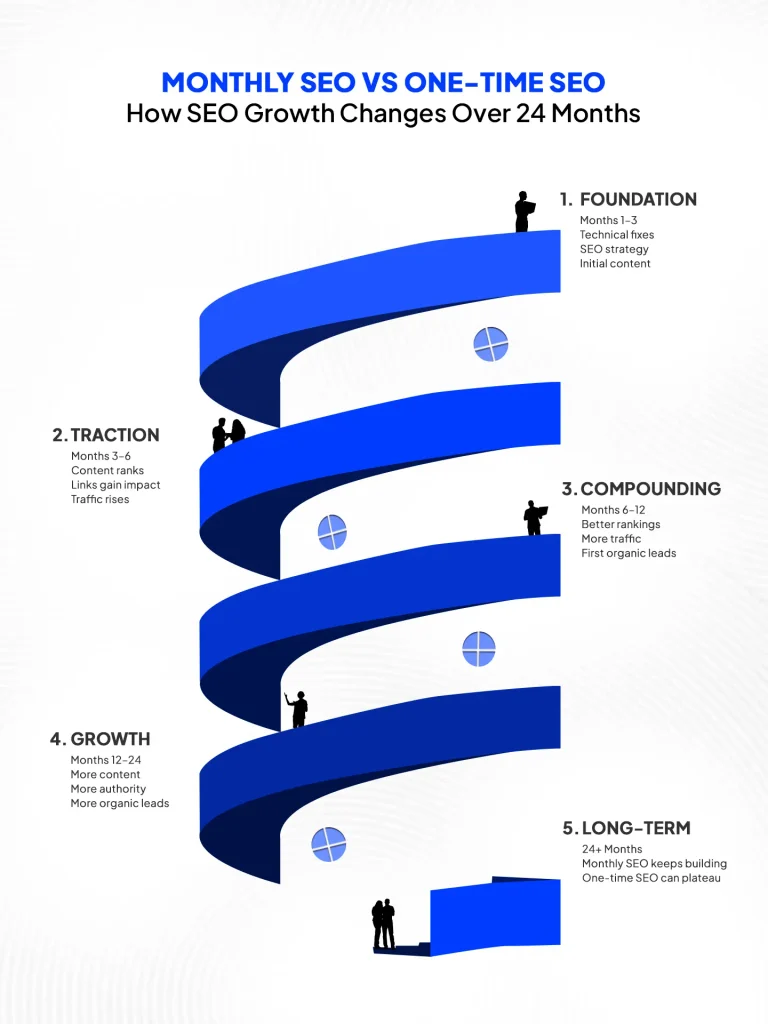
Months 1-3: Mostly foundation. Technical cleanup, strategy, and the first round of content going live. Visible results are modest. And this is often where businesses get impatient. We’ve had clients question the process because they’ve seen only a few new articles go live and expect those pages to start ranking immediately. SEO rarely works that quickly. This is the stage where the groundwork is being laid.
Months 3-6: Content published in month one or two starts to rank. Early link signals begin registering. Traffic begins to trend up instead of going flat.
Months 6-12: Typically at this stage it’s obvious that the strategy is working. Consistent movement in your keyword rankings. Traffic increases that you can see in your analytics without having to squint at the chart. The first real evidence of leads or sales coming from organic search.
Months 12-24: Organic search stops being “something we’re trying” and becomes a genuine, growing organic search acquisition channel. It keeps producing without a matching increase in ad spend.
None of this is achievable through a single project, no matter how well it’s executed. You can’t buy two years of compounding authority in a six-month engagement. This is because the content depth, link equity, technical health, and topical relevance require continuous input to keep building.
ROI Comparison
One-Time SEO ROI: Offers an immediate spike in SEO ROI after initial fixes clear technical roadblocks. However, as competitors adapt and content decays, traffic plateaus or falls, causing your effective ROI to diminish over time.
Monthly SEO ROI: Yields lower ROI in months 1–3 due to upfront investment during the foundational build. By months 12–24, as organic traffic compounds, your cost-per-lead drops significantly. This creates a rising, sustainable ROI curve that outpaces paid media acquisition over time.
Monthly SEO vs One-Time SEO: Cost Comparison Over Time
The sticker price comparison is misleading in both directions, so it’s worth looking at what each option actually costs once time is factored in.
Total Cost of Ownership: 6 Months vs 12 Months vs 24 Months
A one-time SEO project usually costs less upfront than even a few months of a retainer. But “one-time” rarely means one payment. Most businesses that go this route end up rebooking a similar project every six to nine months just to stay competitive. Over two years, that can mean paying for three or four separate projects, without the compounding benefit of having a team working on your SEO continuously.
Another option is hiring in-house. A full-time SEO specialist in the US averages around $83,000 a year in base salary, with a typical range of $65,000 to $115,000 before payroll tax and benefits. And that’s for one generalist. Your business may still need someone for content, link building, design, and technical SEO.
A monthly agency retainer gives you access to those different skills without having to hire each person separately. With ViaENS, for example, your SEO work can involve SEO specialists, writers, designers, and technical developers. That means the different parts of your site can be worked on together, instead of paying one person to cover everything or repeatedly bringing in different specialists when a new issue comes up.
| Timeframe | One-Time SEO ($5,000/project, rebooked every 9 months) | Monthly SEO Retainer ($3,000/mo — mid of the $1,500-$5,000 typical range) | In-House Hire ($83,000/yr base salary) |
|---|---|---|---|
| 6 months | ~$5,000 (1 project) | $18,000 | ~$41,500 base (~$50,000-$54,000 fully loaded) |
| 12 months | ~$10,000 (2 projects) | $36,000 | $83,000 base (~$100,000-$108,000 fully loaded) |
| 24 months | ~$15,000 (3 projects) | $72,000 | $166,000 base (~$199,000-$216,000 fully loaded) |
How to Decide Between Monthly and One-Time SEO
When to choose one-time SEO: You have real technical or on-page issues on your site that are limiting it at the moment. You are in a market where competition is actually thin not just apparently so, or you need a baseline audit before you decide on anything ongoing.
When to choose monthly SEO: You’re in a market with other businesses that are actively investing in SEO. You want organic search to be a meaningful, growing part of your lead flow in the next year or two. You don’t have the in-house team or time to manage content and links yourself
Questions to Ask Before Signing an SEO Agreement
Look where you will, the same questions are the ones that really matter.
- Give me a picture of how things currently stand. Errors, site architecture, current rankings, the backlink profile and where your competitors are.
- What is the plan to fix it and what is the realistic timeline?
- What needs to be done after the first work is finished? Is there any maintenance built in, or does the relationship end there?
- How will I know things are working? What does reporting actually look like, month to month?
- Who am I actually working with? Is there a real point of contact, or am I one account among hundreds?
The answers would solve more for you than the prices would.
Red Flags in Monthly SEO vs. One-time SEO
Red flags in one-time SEO services
- An agency that disappears after the project: If an agency fixes your site once and has nothing to say about what happens next, that’s a red flag. SEO needs monitoring as the site and search results change.
- “SEO training” as a replacement for expertise: Be cautious of training add-ons that hand a staff member a slide deck and a week of calls and call it a replacement for actual SEO expertise. It rarely transfers fully, and if that employee leaves, the business may be starting over.
Red flags in monthly SEO services
- Promises of dramatic ranking jumps in the first month or two: That’s not how organic search usually works. Be cautious of providers making promises they can’t realistically support.
- Vague reporting: You should know what the agency is doing and how the work is affecting your site. If the reports don’t tell you that, ask questions.
- Choosing an agency only because it’s the cheapest: Price matters, but a provider you can’t reach or whose work you can’t understand may not be worth the lower cost.
Is Monthly SEO Worth It?
Pull back from the month-by-month mechanics, and the answer is straightforward: for a business that wants organic search to matter in twelve, eighteen, or twenty-four months, monthly SEO is the only model built to get there. It’s not that one-time SEO doesn’t work, it’s that it wasn’t designed to survive contact with a market that keeps moving after the invoice is paid.
That doesn’t make one-time SEO worthless. It makes it a starting point, not a strategy.
Can I Switch From One-Time to Monthly Later?
Yes, and it’s a common, sensible path. Plenty of businesses start with a one-time audit or technical fix to understand where they stand, then move into a monthly retainer once they’ve decided organic search is worth the ongoing investment. There’s no penalty for starting small.
Conclusion
If you’re deciding between monthly SEO vs. one-time SEO, start with what you actually need from SEO. For long-term growth, we would say that monthly SEO is a wise choice. Not because one-time SEO is a bad product, but because organic search isn’t a problem you solve once. You have to keep earning, month after month, against competitors who are also not standing still.
One-time SEO fixes what’s broken, prepares for a migration, and establishes a baseline. But if you are looking for long-term business growth, it requires sustained, adaptive work only a monthly SEO retainer is actually built to deliver.
If you’re trying to figure out which model makes sense for where your business stands right now, we can walk through your current site, your market, and your goals and tell you honestly which option fits.
FAQ
Are Monthly SEO Packages Worth It for Small Businesses?
According to the U.S. Small Business Administration (SBA), small businesses typically allocate 7%–8% of revenue to marketing, or 10%–12% for aggressive growth. A smaller SEO package maintained consistently for a year can be more valuable than a large one-off project lasting 90 days.
What Kind of Results Can I Expect From a One-Off SEO Project vs a Monthly Retainer?
One-off projects can deliver faster results through technical fixes and on-page improvements, sometimes within weeks. Monthly SEO takes longer, often 3–6 months to show clear results and 12+ months to compound, but its results can continue building rather than plateauing.
Do SEO Results Fade Away If I Stop Monthly SEO?
Not necessarily. A well-optimized site with strong content and authority may maintain its rankings for months without ongoing SEO. However, rankings can gradually decline as content gets outdated, competitors improve, or search algorithms change.