
You can be great at SEO and still have an empty pipeline. We have seen it more times than we can count over our 12 years in the industry, both with solo freelancers and with agency owners who have a team of ten behind them. It is painfully common to see someone who can rank a site in their sleep sitting there refreshing their inbox because nobody is emailing them. SEO and client acquisition are two completely different skill sets, and almost nobody teaches the second one.
This guide covers that missing second skill. We are not going to give you a generic list of tips like “post on LinkedIn and hope for the best.” Instead, we will walk you through exactly how to define who you are chasing, how to find them, what to charge, how to close them, and how to retain them long-term. Every single tactic and strategy outlined here comes directly from our own 12-year journey within the industry, built on the exact mistakes we made, tested, and fixed along the way.
Key Takeaways
- Most freelancers and agencies lose clients before they even pitch. They sell deliverables instead of outcomes, stay a generalist, or bet everything on one channel.
- Any single “best” tactic is beaten by a mix of 3-4 channels.
- Cold email is still working in 2026, but you need a proper domain set up and a well-built list of prospects behind it, not just a template.
- Referrals convert better than just about anything else.
- Getting the client is only half the job. Keeping them, including how you onboard them in the first 30 days, decides whether your pipeline problem comes back in six months.
Why You Aren’t Landing Clients Yet
Before any tactic on this page will work, check whether one of these three things is quietly sabotaging you. We have been guilty of all three.
Selling Deliverables, Not Revenue
Saying “I will write 8 blog posts and build 20 backlinks a month” means very little to a business owner. They do not want blog posts; they want more paying customers. For years, our own agency fell directly into this trap. On sales calls, our entire pitch boiled down to asking, “How many backlinks do you want? Tell us and we will deliver them.” We never talked about revenue, ROI, or the overall strategy required to move rankings. We were selling isolated backlinks instead of business outcomes, and our low conversion rate reflected that mistake. Every pitch, post, and cold email you send must focus on what changes for their business bottom line. If your proposals list tasks before explaining outcomes, that is the first thing you need to fix.
The “Generalist” Trap
“I do SEO for anyone” sounds like a strategy that opens doors, but it actually closes them. When a prospect compares you to a specialist who says “I handle SEO for mid-sized law firms,” they will pick the specialist every time because specialization feels like less of a gamble. When we started out, we neglected to define an Ideal Client Profile (ICP). As a result, everything we published and sent out sounded generic, like we were pitching anyone with a website. Generic positioning is the primary reason skilled freelancers and agencies fail to get replies.
Single-Tactic Dependency
If cold email is the only thing filling your pipeline, you don’t have a client acquisition system. You have a single point of failure where deliverability issues, algorithm shifts, or a bad month of reply rates can completely stall your business. We know this because we were guilty of running on cold outreach alone for far longer than we should have.
This is why we’re now actively building out cold calling, paid ads, and organic channels like our own SEO alongside it. Most reliable guides on this topic land on the exact same conclusion: a mix of 3-4 channels run simultaneously always beats relying on one “best” tactic in isolation, ensuring one slow channel never sinks your entire pipeline.
Get These 3 Things Right
Skip this section and every tactic in the rest of this article gets harder. Everything else sits on this foundation.
1. Define Your Ideal Client (ICP)
Answer these questions before you touch outreach or content:
- What size of business can afford your services, and what size can’t yet?
- What industry do you understand well enough to talk about specifics, not just SEO theory? Put differently, is this an industry you already know well, or are you learning it on the client’s money?
- Do they already have a content or marketing team you’d be working alongside, or are you the whole department?
- What’s the actual pain making them search for help right now?
Then pick a lane. The moment we stopped emailing every website owner and focused on a handful of specific sectors, we booked more sales calls in a single month within one industry than we had across the previous six months combined. So, replace generic targets like “small businesses” with specific profiles like “local personal injury law firms,” “B2B SaaS companies under 50 employees,” or “high-growth Shopify brands.” The more specific you position yourself, the easier every outreach channel becomes because your messaging finally speaks to one specific buyer. Narrowing our target profile was the single biggest operational pivot we ever made.
2. Build a Results-Based Offer
Position your offer around what changes for the client rather than what tasks you will perform. Saying “I will get your site ranked for your primary high-intent services in your city” is far more compelling than “I sell monthly SEO packages.”
In our early days, pitching generic SEO and link building got us ignored because prospects could not connect the service to their revenue. We turned that around by identifying where a prospect was actively losing traffic, revenue, or market share to competitors, and building our offer directly around closing that specific gap. This is where a wedge offer shines: you ease a hesitant prospect in with a low-risk micro-audit or a specific technical fix, then leverage that initial win into a full monthly retainer.
3. Know Where Your Ideal Clients Actually Spend Time
This sounds obvious until you try to answer it. A life-coaching business owner and a SaaS founder are not hanging out in the same places. One might be in Facebook groups, the other on LinkedIn or a niche Slack community. Tools like SparkToro exist to answer “where does my audience spend time”, but even without a tool, this is worth 20 minutes of honest thinking before you pick a channel to invest in.

The “Zero-Client” Proof Strategy
For the people who are just starting out, because a brand new freelancer or a brand new agency is the one without case studies. However, if you have been operating for a few years and still cannot point to a documented growth story, your problem is not client acquisition; it is delivery. Fix your campaign execution first, because valid proof should naturally accumulate over time.
If you have zero case studies, you’re not stuck. You just need a different starting move, and two things work here consistently. First, tell everyone you know that you’re doing this. Former colleagues and old employers are a legitimate source of first clients, not just a cliché. Second, offer a results-based deal to one or two local businesses or people in your own network in exchange for a case study. You don’t need to work for free forever, just long enough to have one number you can point to. Once you’ve got that, you start selling proof instead of promises.
How Top Freelancers and Agencies Build a Predictable Pipeline
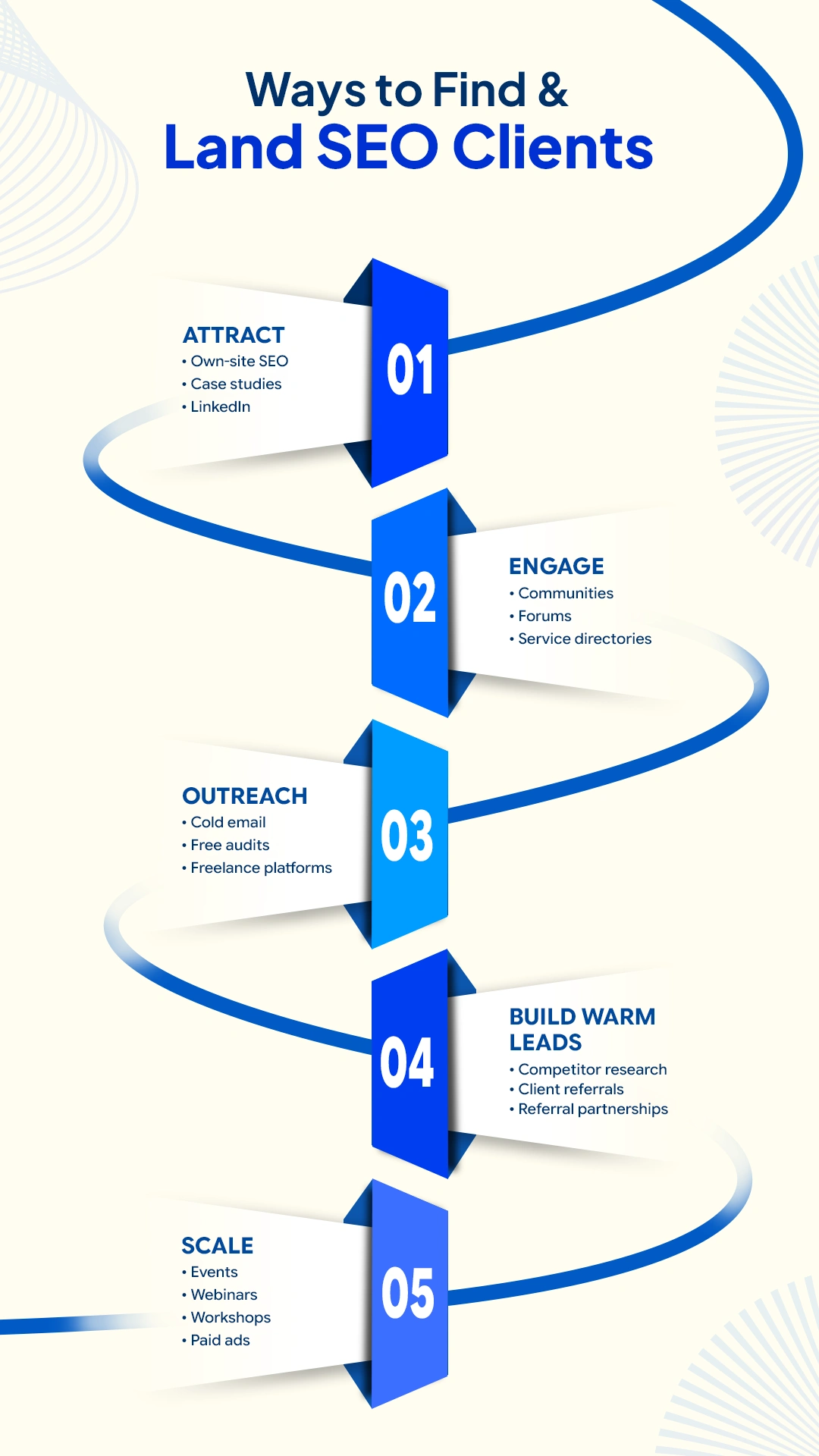
Here’s the thing nobody tells you: the freelancers and the agencies with steady pipelines aren’t doing one thing brilliantly. They’re running 3-4 channels at low-to-medium effort at the same time, so a slow month on one doesn’t sink the business. That’s the antidote to the single-tactic dependency problem from earlier. Pick your channels deliberately from the list below instead of defaulting to whatever you saw someone else doing.
13 Ways to Find and Land SEO Clients
Inbound Methods (Let Clients Come to You)
1. Rank Your Own Website First
If you can’t rank your own site, that’s the first question any smart prospect will ask you. Go after the keywords your ideal client is actually searching for, not generic terms like “SEO agency”. Think “why is my Shopify store not showing up on Google”, “how to rank a law firm website in [city]”, “SaaS content strategy for early-stage startups,” or “how to fix a traffic drop after a site migration”. Those are buyer problems with a service attached. Don’t build your whole content strategy around SEO industry keywords like “how to do keyword research”. Your buyers aren’t searching that. Write about the problems they’re Googling instead, tied to their industry.
2. Publish Case Studies and Educational Content
Publishing verified GSC case studies more than doubled the influx of our qualified inbound leads. In fact, one enterprise client told us directly that they booked a call solely because we published a detailed case study featuring one of their direct competitors. Verified proof drives sales faster than almost anything else.
But what kind of case study do you need? Well, a case study works best as a story. Instead of a stats dump, talk about where the client started, what was broken, what you did, and the number that changed. Two things to get right from the start. Don’t publish a client’s name or site without permission. And when you’re sharing a win publicly, use a screenshot from Google Search Console instead of a third-party tool. Anyone can run a site through Ahrefs and claim credit. Only the person who did the work has access to that site’s own GSC data, and that’s what makes the proof credible.
3. Get SEO Clients on LinkedIn
The mistake almost everyone makes here is connecting with someone and pitching in the same breath. Don’t. Share what you’re learning on client work, leave real insight in the comments on other people’s posts, and let people find your services page through your profile instead of a cold pitch. Rewrite your headline so it says who you help and what outcome you deliver, not just “SEO Specialist”.
4. Show Up in Communities and Forums
Reddit, niche Slack groups, Indie Hackers and industry Facebook groups. The rule is simple, and almost everyone breaks it anyway: answer the question, don’t pitch. “Try consolidating your lowest-performing posts, they might be cannibalizing each other” gets you a DM. “DM me, I offer affordable SEO tailored to your business” gets you ignored. Give away the answer. People check your profile when the answer is good, and that’s where the conversation starts.
Being genuinely active in the right communities will put you in front of the exact people who need your services, long before they start shopping for an SEO provider. One niche community where your buyers actually hang out beats ten general marketing groups.
5. Get Listed on Service Directories
Clutch, The Manifest and niche-specific directories all let potential clients find you while they’re actively comparing providers, which is about as warm as a lead gets. Your profile is doing the selling here, so treat it like landing page copy. A named niche, case studies and reviews from real clients do the work. Local directory searches like “SEO agencies in [city]” are lower competition too, worth starting there if you’re new to this.
Your visibility on these platforms matters even when the lead did not come from them. After a sales call, prospects go looking for you. They want to see your reviews and read what other clients say before they sign anything. An empty or half-finished directory profile at that moment costs you deals you thought you had already won.
Outbound Methods (Go Find Them)
6. Cold Email Outreach
Cold email still works in 2026, but only with the plumbing done properly. Don’t send from your main business domain, because one spam complaint can take your primary inbox’s reputation with it. Buy a separate sending domain, authenticate it, and warm it up gradually for two to three weeks before any outreach goes out.
Your list decides your results. A great email to the wrong person converts at zero. Filter by company size, because smaller teams are more likely to outsource SEO entirely, and by industry and funding stage, because a recently funded company is under pressure to scale without an SEO hire. A focused list of 50 well-matched prospects beats 500 scraped ones.
Keep the first email short: one observation about their site, one concrete thing you can do, one low-barrier call to action. Naming a keyword their competitor ranks for and offering to send a quick analysis beats a general sales pitch every time. Most replies come from the follow-ups, so plan a short sequence where each message carries a new finding, a relevant case study, or something useful they can use even if they never hire you. Every message needs a reason to exist beyond “just following up”.
7. Offer Free SEO Audits and Quick Wins
Over our 12 years in business, we have consistently used live video audits during initial discovery calls. Prospects may view unsolicited 20-page-long audits as spam. A short, personal video walking through 2-3 fixable issues on a prospect’s site does more, because it’s proof you looked. Taking them through their own site errors in real time builds immediate trust because you are actively demonstrating expertise rather than just pitching a service. If you can, take it a notch further and fix a small problem for free, like a title tag or a hole in their Google Business Profile. Let the change settle for one to two weeks. Once they see a bump inside that window, the conversation stops being “should I hire somebody” and becomes “how do I keep this going”.
8. Start on Freelance Platforms
If you’re at zero clients and zero case studies, Upwork, Fiverr Pro and PeoplePerHour are legitimate places to start, not something to be embarrassed about. The trick is positioning. “I do SEO” is a race to the bottom on these platforms. “I’ll get your Shopify store ranking for [specific term]” isn’t. Expect platform fees to eat into your margin. Upwork and Fiverr both take a meaningful cut, so treat your first 3-5 projects as an investment in reviews and proof, not income.
Don’t assume this is only a stepping stone, either. Plenty of established freelancers and full agencies still count these platforms among their biggest sources of new clients every single month. Once your profile has reviews and a clear niche behind it, the platform starts sending you work instead of the other way round. Move off-platform when it makes commercial sense, not because you think you have outgrown it.
Publishing a new gig on Fiverr may also attract automated phishing scams targeting new sellers. Never enter credit card details or click external links to “verify” an order. Real sales run automatically inside your dashboard. Ignore buyers asking to move the conversation to Telegram or WhatsApp, or asking you to scan a QR code or share a direct email address. Block and report these messages immediately so they don’t harm your profile response rate.
9. Track Competitors to Find Warm Leads
Look for the keywords your ideal client would care about, then look at the sites ranking three to five pages back, not the ones on page one. These are businesses that are trying and not quite making it, which makes them warmer. Tools like Ahrefs and Semrush speed this up. Filter by niche or industry and you can build a list of sites with visible, fixable problems.
10. Ask for Referrals From Existing Clients
At viaENS, a large share of our clients have arrived because someone they knew had a good experience with us and passed our name along. Hence, we believe that this is the highest-converting channel on this entire list. Yet, many freelancers and agencies don’t have a system for it. They just hope it happens. Ask right after a confirmation, not when you’re sending the invoice. According to Tallyfy, referred customers close at meaningfully higher rates than cold outreach, and word of mouth is a top driver of customer decisions. That matches what most of us see anecdotally. A warm introduction skips half the trust-building a cold pitch requires.
We believe that it doesn’t work on a clever system. Do quality work, actually deliver the results you promised, and your clients will start referring you without being asked. We have watched it happen over and over.
11. Build Referral Partnerships
Web designers, PPC freelancers, accountants and business coaches all talk to your exact target client and don’t offer SEO themselves. That makes them one of the easiest warm-lead sources available if you approach it right. A referral fee of 10-15% of the first project’s value is fairly standard, and it works both ways, so refer clients to them too. It can also run in the other direction. Freelancers get brought in as overflow capacity by agencies during busy periods, and agencies pass specialist work out to trusted freelancers. Either way, that is a steady source of work on its own.
12. Speak at Events, Run Webinars and Workshops
Skip generic SEO meetups. That room is full of other SEOs, not clients. Go where your niche actually gathers. A Chamber of Commerce event if you work with local businesses, or a SaaS meetup if that’s your niche. A free 30-minute talk with a practical title like “Three Reasons Your Site Isn’t Visible on Google” beats a sales pitch from the stage.
At a recent SaaS industry event, presenting to a room of 300 founders resulted in 14 booked discovery calls and 5 signed long-term clients. This becomes difficult at generic SEO events, because the room is often be full of people selling SEO and almost no one buying it.
13. Use Paid Ads to Fill Pipeline Gaps
Some of the biggest players in the link-building industry make excellent use of paid ads. They push over 5,000 orders a month and roughly 90% of that volume comes from paid ads. On paper it sounds fragile. But paid ads can be the fastest way to fill a gap and the easiest way to lose money if you skip the math. Do the math before you spend.
If you close 1 client for every 30 leads and your average project is worth $3,000, your maximum cost per lead is $100. Google Ads on competitive SEO terms can run well past that per click in some markets, so this channel makes sense once you know your numbers, not before.
How Much Should You Charge SEO Clients?
Numbers vary a lot by scope and niche, but here’s the range based on public data. Ahrefs surveyed 439 SEO providers and found freelancers average $1,348 a month against agencies at $3,209, a 138% gap. Hourly contract rates run from around $50 for standard work to over $150 for an expert consultant, and one-off projects like audits and migrations usually land between $500 and $5,000.
Choose your billing wisely, not habitually
- Monthly retainers make sense once you’re experienced and need a dependable income stream.
- Fixed project rates make sense for clearly defined, one-off work such as an audit, a migration or a content sprint.
- Result-based payments can win over a skeptic. Only take that deal if you control the levers that drive the result, because you’re taking on risk you can’t always manage.
Whatever model you pick, price around the value you’re creating, not the hours you’ll spend. If your work is realistically going to add $20,000 a month in revenue for a client, a $2,000 retainer is a bargain to them, and pricing lower just leaves money on the table. Look at it from their side. If you know you can deliver, and the revenue you add is several times your fee, then your retainer is an asset on their books, not a cost. Price it that way and say it out loud on the call.
How to Convert Leads Into Paying Clients
Finding the lead is half the job. This is the half most guides skip, and it’s where a lot of deals get lost that should have been won. Everything below is what we learned the slow way, by losing deals we were qualified to win.
Qualifying Leads and Spotting Red Flags
After many years of sales calls, we can tell you plainly that not every lead is worth your time, and working that out early saves you from a painful engagement later. Watch for a few signals before you invest hours in a proposal: no realistic budget for what they’re asking, a business that doesn’t understand why SEO takes months rather than weeks, or someone who’s already burned through two or three providers with no reflection on why. None of these is an automatic disqualifier, but each is worth a direct conversation before you write anything up.
At viaENS, we make sure that if we cannot deliver the results a prospect is expecting, we say so and not take them on. Saying yes to an overexpectation is not a win. It is a bad review waiting six or twelve months down the line, once it becomes obvious the promise was never deliverable.
The Discovery Call Framework
The day we stopped treating discovery calls as pitches, our conversion rate went up. Treat it as a consultation, not a sales pitch. The framing changes how the call goes. Go in aiming to understand their pain points, get a real sense of their budget, and note anything you can reference later in the proposal. Not every discovery call turns into a client, and that’s fine. The ones that don’t are still cheaper than a proposal written for someone who was never going to say yes.
Structuring High-Converting SEO Proposals
A real proposal takes time, because you have to dig properly into the prospect’s site first. If you can write it in twenty minutes, it is a template, and it will read like one. Don’t write a full proposal before you’ve agreed a rough price range on the call. If your number is well outside their budget, you’ll find out for free instead of after hours of work. When you build it, lead with the growth they get rather than the list of steps you’ll take, and give them 2-3 options instead of a single take-it-or-leave-it price. It’s much easier for someone to pick an option than to say no to all of it.
Overcoming Common Sales Objections
“We tried SEO before and it didn’t work” comes up constantly, and it’s rarely the real problem. Usually it means vague reporting or a previous provider who overpromised. Find out what “didn’t work” actually means before you answer it. “We can’t afford it right now” usually means “I can’t see the ROI clearly enough”, which is a signal to show the math, not to drop your price.
Expect to be compared. In almost every deal, the prospect is weighing you against other SEO vendors, sometimes cheaper ones. Your job in that moment is not to defend your price. It is to show why your work is built around results and how those results grow their business. Whoever explains that most clearly usually wins the deal.
How to Keep the SEO Clients You Land
Winning the client is not the finish line. We have clients who have been with us for three, four years and more, and not just one or two of them. Plenty of businesses burn through clients as fast as they win them, and it almost always traces back to week one, not week six. Now, if you ask us, what keeps them, it comes down to two things. We set clear expectations up front, and we consistently deliver more than we promised, in quality and in volume.
Nail onboarding from the start: a kickoff call, access to the tools and accounts you need, and a 30/60/90-day document that sets expectations on pacing. After that, keep the relationship healthy. Report on business outcomes, not just traffic and positions, so leads and revenue are in the conversation. Be honest about timelines from day one, or you’ll look ineffective after the first two weeks. And keep filling the pipeline while you’re in delivery mode, so losing one client, which everyone eventually does, never puts the whole business at risk.
Final Thoughts
A clear niche and a results-based offer come first. Get those two right, then pick 3-4 of the 13 methods above and commit to them instead of dabbling in all thirteen at once. Cold email and referrals compound especially well together. Cold email brings in the first clients, and once you’ve delivered for them, referrals start doing a growing share of the work.
If we had to leave you with one thing, it would be this. Every compounding pipeline we have seen, ours included, was built by people who thought about what they were giving the client rather than what they could extract from them. Deliver more than you promised and the referrals, the case studies and the repeat business follow on their own. Pick your channels, give them real time before you judge them, and keep the pipeline moving even in the months when you are buried in delivery. That last part is the one almost everyone, us included, learns the hard way.
FAQs
-
How long does it take to get your first SEO client?
It depends on the channel. Referrals can be instant if you have a network to tap, cold email usually produces replies in 1-2 weeks and a signed client in 30-60 days, and inbound content typically takes 3-6 months. Don’t rely on inbound for your first clients.
-
What’s the fastest way to get SEO clients?
Cold email paired with a short, personal video audit. Build a tight list of 50 well-matched prospects and record a 2-3 minute video on each site pointing out fixable issues. It’s more work than a template, but reply rates are much higher because it’s obviously not mass-produced.
-
Can I get SEO clients with no experience?
Yes. Rank your own site for a real keyword, then do one project for a local business or someone in your network, paid, discounted, or results-based. Get a testimonial and permission to use the numbers, and you have proof to point at in every pitch after that.
-
Do I need a niche to get SEO clients?
Not strictly, but it makes everything easier. “I do SEO for B2B SaaS companies” gets remembered and referred while “I do SEO” gets forgotten. Pick a niche you already understand and widen it later once you have momentum.
-
Should I offer free trials or free SEO audits?
Free audits yes, free trials, no. Weeks of unpaid work for someone who hasn’t committed is a bad trade, while a short audit proves your thinking and gives you a natural next step to pitch the retainer. Keep it personal and brief rather than a 20-page report nobody asked for.
-
How much should I charge for my first SEO retainer?
Somewhere around $500 to $1,500 a month is reasonable before you have case studies, based on the freelancer figures above. Price low enough to win the proof, high enough that it doesn’t read as amateur, then raise your rate for the next client. Don’t let your first number become your long-term anchor.
-
How do I pitch SEO services to potential clients?
Lead with the outcome, not the task list, and reference something specific about their site before you mention your services. Generic pitches get deleted unread. Don’t write the full proposal until you have a sense of their budget from a real conversation.
-
Is cold email for SEO client acquisition still effective in 2026?
Yes, but the bar has moved. According to EmailBison, generic mass sends average around a 3.43% reply rate , while targeted, data-backed outreach hits 8% to 12% or more, confirmed by Lacleo research. That means short plain-text emails under 80 words, sent from an authenticated secondary domain to micro-lists of fewer than 50 prospects.
-
How can I get local SEO clients when I’m just starting out?
Local SEO is less competitive and shows results faster, which makes it a good starting point. Search a high-value local service keyword, open the businesses sitting on pages 2 to 5, and find one obvious fixable problem such as a missing Google Business Profile or an unoptimised service page. Email them what you found and offer to fix it.
1 thought on “How to Get SEO Clients: 13 Proven Ways to Fill Your Pipeline”
Comments are closed.