
Agencies often handle SEO for multiple clients at the same time. While one client may require technical SEO, another can demand for a content optimization or the ranking growth across different countries. Here, SEO reporting becomes a complex task. A white-label partner might be working perfectly behind the scene, but if SEO reporting does not provide clarification on tasks, the client will always be guessing around the ground work.
This is one of the most common problems in white label SEO. A client may ask simple questions like:
- Where did this backlink come from?
- Why is the anchor text different from what we approved?
- Was this technical issue fixed or only mentioned in the audit?
- Is the placement still live after three months?
- Did this content improve rankings or only get published?
- Are these AI search mentions real or just assumptions?
White label SEO reporting is the layer that positions your company as a strategic partner in front of the brand hired. A strong report protects the agency, gives the client clarity, and keeps the white label partner accountable.
What Is White Label SEO Reporting?
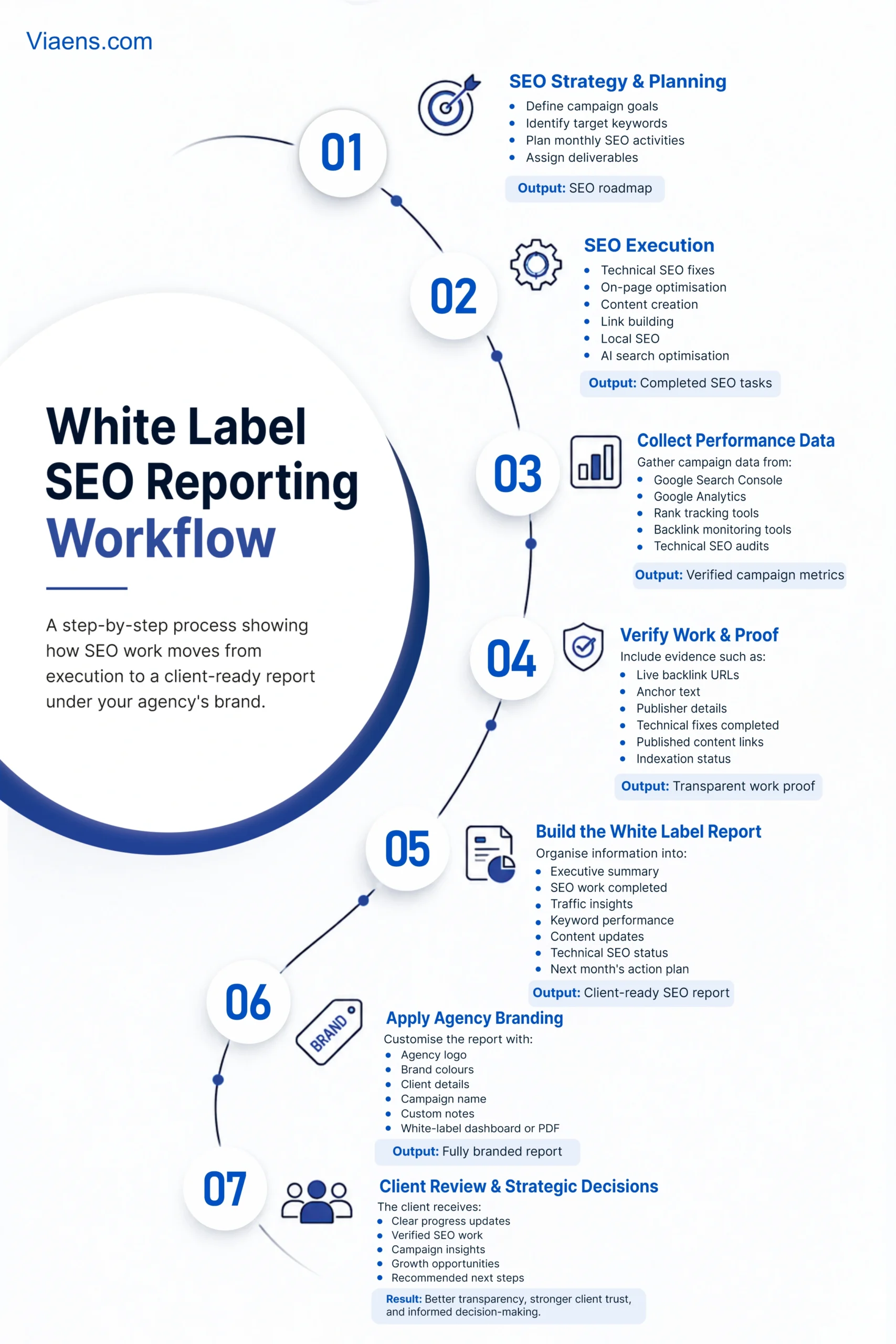
White label SEO reporting is the process of presenting SEO work under your agency’s brand while a specialist partner handles some or all of the delivery in the background.
A white-label partner offers services such as off-page SEO, content creation, high-authority link building, AI search tracking, or campaign execution.
For example, your agency may sell a complete SEO package to a SaaS company, and reporting includes everything from managing SEO strategy to client communication, technical audits, content delivery, publisher outreach, and monthly reporting.
Good white label SEO reporting should show:
- Work- Planned, Executed and Completed.
- Pending Tasks.
- Monthly Reporting.
- Achieved Outcomes.
- Tasks In Progress.
- Work Proof.
This makes the report useful for the agency and the client.
Why White Label SEO Reporting Matters?
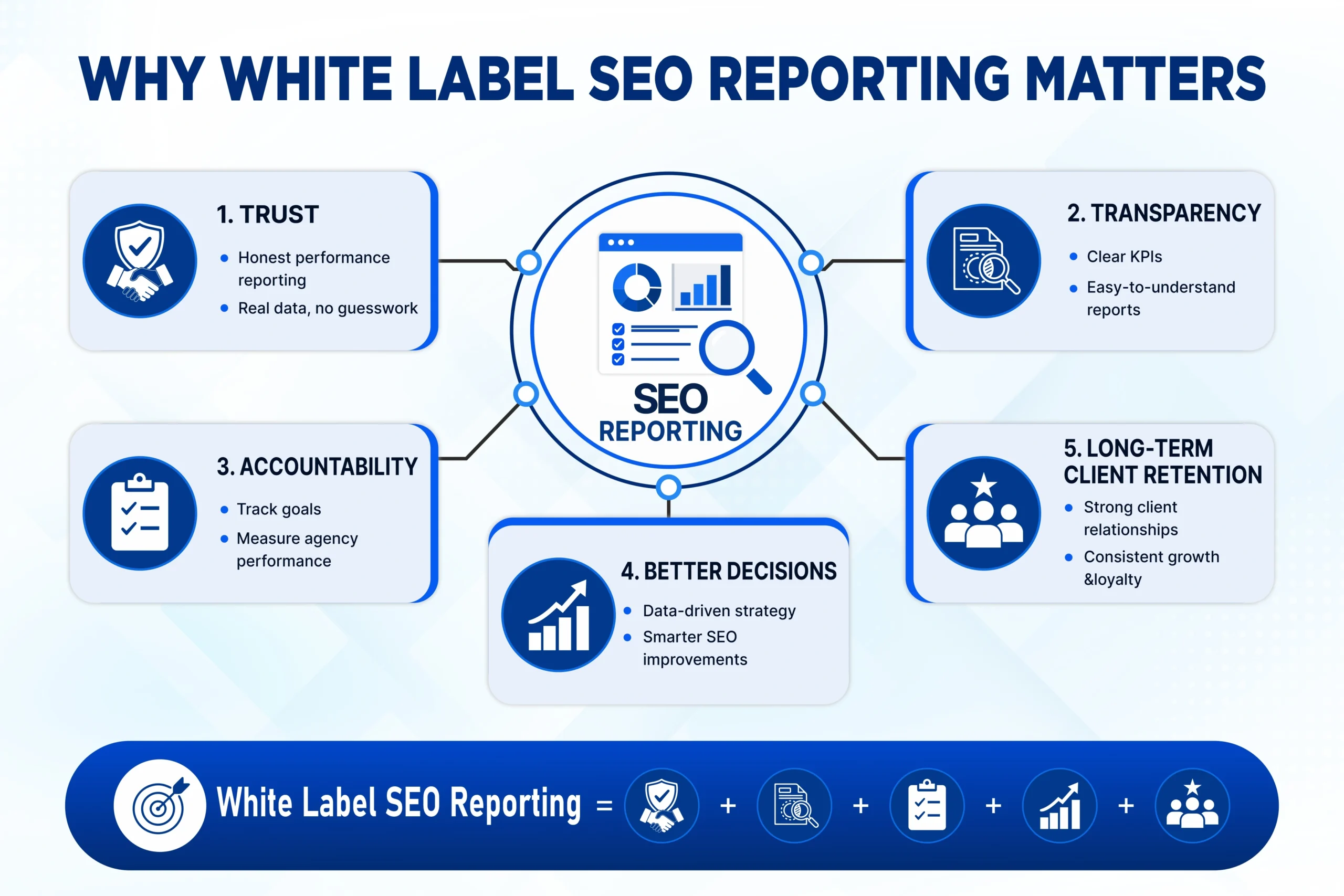
Client demands for the proof, context, and direction, and without documentation that is hard to provide. White label SEO reporting matters because SEO has too many moving parts to be explained with one ranking screenshot or one traffic graph. Here is how SEO reporting helps the agencies:
- Protects the agency-client relationship
When the client asks for details, your agency should not have to chase the white label partner for answers every time. A proper report gives you the information before the client asks.
This helps your agency look prepared, organised, and in control. The client feels that your team understands the work, even when some execution is handled by a partner.
- Proves that work was actually completed
A report must clearly define the tasks that have been completed with respective links and sources.
For example, if broken links were fixed, the report should show the affected URLs and the current status. If backlinks were built, the report should show live URLs, anchor text, target pages, publisher details, and indexation status.
- Keeps the white label partner accountable
A white label partner should not disappear after sending a few numbers. Reporting keeps every task traceable.
If a placement goes down, if a keyword drops, or if an agreed anchor changes, the report helps the agency identify the issue quickly. Without this, the agency may only find problems after the client complains.
- Helps clients understand SEO progress
SEO results are not always immediate. Sometimes the work done this month supports results three months later. The White-Label SEO report must connect the actions with expected outcomes, and shows how these actions are supporting the long-term growth of a particular brand or service.
- Reduces confusion between activity and results
Many reports show a long list of tasks but do not explain whether those tasks created any movement. This creates a false sense of progress.
A better report separates activity from impact by defining the tasks that have been done, the results achieved, and processes that require more time and attention.
- Supports better decision-making
White Label SEO report further supports the decision making process. For example- If rankings are improving but conversions are flat, the next task might require the landing page update. And, if the traffic is sourcing from the wrong place, that link building or content optimization needs improvement.
Thus, reporting helps to figure out what will be the next move for growth.
Why White-Label SEO Reporting Beat a Dull Report Every Time?
A dull report only displays results in numbers, whereas a white-label SEO report provides detailed explanation of each task executed. This clarity in work, and results contributes to the future growth across every SEO campaign.
| Description | Dull Report | White-Label SEO Report |
|---|---|---|
| Work Updates | Lists tasks vaguely. | Shows completed, pending, and in-progress work. |
| Proof of Work | Gives little or no proof. | Shares live URLs, links, and task records. |
| Performance Data | Shows numbers without meaning. | Explains rankings, traffic, and movement clearly. |
| Link Reporting | Mentions links built. | Shows anchor text, target URL, publisher, and live status. |
| Technical SEO | Lists issues repeatedly. | Tracks fixed, open, and pending issues. |
| Content Updates | Says content was published. | Shows target keywords, page purpose, and results. |
| Client Clarity | Creates more questions. | Gives clear answers before the client asks. |
| Strategy Value | Feels like a monthly formality. | Helps plan the next SEO actions. |
| Agency Image | Looks basic and unprepared. | Looks branded, organised, and client-ready. |
The Branding Layer To Your White Label SEO Report
Branding in the White-label SEO Report is a baseline requirement.
If your agency is presenting SEO work to a client, the report should look like it came from your agency, not from a third-party vendor. A generic spreadsheet, plain PDF, or tool export can weaken trust, even when the actual work is good.
A branded report keeps the client experience consistent. The client hired your agency, speaks to your team, and expects your process. The report should support that relationship. Complete branding customisation should include:
- Agency Logo
- Brand Colours
- Agency Contact details
- Client Name and Campaign Name
- Custom Report Cover
- White Label Dashboard or PDF format
- Agency-Owned Notes and Recommendations
- Custom Section Names Based on the Agency’s Service Model
- No Third-Party Partner Branding
- Report Format Suitable for Direct Client Sharing
A well-branded report tells the client that your agency owns the strategy, understands the delivery, and has control over the process. A basic template report tells them that the work may have simply been passed from one vendor to another.
White Label Reporting for International and Multi-Niche Campaigns
A normal SEO report may work for a single-country, single-service campaign. But it does not work well when a client is targeting multiple countries, industries, or service lines.
When a client runs SEO across the US, UK, and Australia, one number like “organic traffic grew 18%” is not enough, because every country has different metrics, while traffic in one might be growing, the other may have dropped.
The same logic applied to the rankings, link building, content, conversions, and AI visibility.
To handle the Multi-market and multi-niche campaigns, agencies require a segmented reporting, which explains each and every update in a resourceful manner.
- Country-Level Segmentation
The segmentation for targeted countries should be done as per rankings, conversion and placements. For example- the record kept for backlinks for US must not be counted for the UK campaign until it is not contributing to their market.
The white-label SEO report must clearly define the work and the targeted country. This helps the agencies to have an understanding of the market, and figure out the next steps to be taken.
- Niche-Tagged Placements
Some clients run campaigns across several verticals. A brand may need SEO support for finance, health, SaaS, home improvement, and professional services at the same time.
In that case, every placement, content asset, and authority-building activity should be tagged by niche. This helps the agency show progress by vertical instead of showing one mixed total.
A finance placement and a home improvement placement do not serve the same campaign goal.
- Per-Market Keyword Tracking
The same keyword can perform differently in different countries.
A keyword may rank on page one in the UK, page three in the US, and not rank at all in Australia. If the report averages this data, the client gets a misleading picture.
Each target market should have separate keyword tracking, separate movement, and separate commentary.
- Localised Content Tracking
Content created for a specific market should be reported against that market.
For example, a UK landing page should be measured against UK rankings, UK traffic, and UK conversions. It should not be judged only inside the total website traffic number.
This helps clients understand whether localisation is working.
- Service-Line Segmentation
For multi-service businesses, reports should separate SEO performance by service area.
A law firm may have personal injury, family law, immigration, and corporate law pages. A SaaS company may have different product lines. A healthcare brand may have different treatment categories.
Each service line needs its own visibility, content, keyword, and conversion view.
- Market-Specific Recommendations
International reporting should not end with one generic recommendation.
If the US market needs authority building, the UK market needs content refreshes, and Australia needs local citations, the report should say that clearly.
This is where reporting becomes strategic instead of just descriptive.
Key Sections To Include In A White Label SEO Report
A useful SEO report template should be simple, branded, and easy to understand. It should include the sections that matter most to the client.
- Report Header And Branding
The report should start with a professional header or cover page. This section should include the report title, agency logo, client name, website URL, campaign name, and reporting date range.
Branding is important because the client should feel that the report came directly from your agency.
- Executive Summary
The executive summary gives the client a quick overview of the month’s SEO performance. It should include major wins, important issues, completed tasks, and areas that need attention.
Many clients do not read every section in detail, so this part should quickly explain the direction of the SEO campaign.
- Organic Traffic Analysis
Organic traffic analysis should show how the website is performing in search engines. Include organic sessions, clicks, impressions, users, engagement, and traffic changes.
This section helps clients understand whether the website is gaining more visibility and attracting more visitors from Google search.
- Keyword Performance
Keyword reporting should include winning keywords, losing keywords, current rankings, ranking movement, target pages, and search intent.
A good SEO keyword ranking report should not only show positive movement. It should also show drops and keywords that need more optimization.
- Content Performance
Content analysis should show which blog posts, landing pages, or service pages improved and which ones need more work.
This section can include content updates, new content published, top-performing pages, losing pages, keyword targeting, and optimisation notes. It connects content marketing with SEO results.
- SEO Work Completed
The report should clearly define the SEO tasks that have been completed along with date and time. This can include the technical SEO, on-page optimization, off page tasks, SEO updates, backlinking, internal links, or other SEO activities. Clear reporting of executed SEO tasks helps to identify the actual numbers behind the effort.
- Customising The White Label SEO Report
A professional white label SEO report should match the agency’s brand identity. Add your agency logo, colours, custom notes, footer text, email subject, and selected report sections.
The goal is to create a client-ready SEO report that looks polished and easy to share.
Red Flags To Avoid In A White Label Provider’s Reports
Not every white label SEO report is useful. Some reports may look clean, but they fail when the client asks detailed questions. A strong report should be transparent, verifiable, and connected to actual SEO work. Here are the main red flags agencies and brands should watch for.
- Delivered Status Without Live URLs
If a report says work is “delivered” but does not show live URLs, it is incomplete. Clients should be able to verify backlinks, content placements, citations, and published pages. Without live URLs, the report asks the client to trust the work without real proof.
- DR-Only Link Reporting
Domain Rating is crucial, but it is not the only element for strong link building. A proper link building report must provide clear insights on niche relevance, anchor text, target URL, page, traffic metrics, link type, placement date, and live status. A high DR score alone does not prove link quality.
- Technical Audits Without Fix Tracking
Some reports list technical SEO issues every month but never explain what was fixed. This creates confusion. A useful technical SEO report should separate open issues, resolved issues, pending tasks, and completed fixes.
- Content Reports Without Outcomes
Publishing content is not the same as improving SEO performance. A content report should show target keywords, page purpose, optimisation work, indexation status, ranking movement, and organic traffic where available.
- Confusing Links Built With Links Live
A link may be ordered or approved, but that does not mean it is live or indexed. Reports should separate planned links, in-progress links, live links, removed links, and indexed links.
- Ranking Growth Without Traffic Context
Keyword ranking growth means little if it does not bring clicks, impressions, traffic, leads, or conversions. Ranking data should always be connected with business impact.
- Vague Or Repeated Reporting
Identical monthly reports, vague AI search claims, missing segmentation, and unverifiable data are major warning signs. A good report should explain changes clearly and show real campaign progress.
Final Thoughts
White Label SEO report is crucial for maintaining long-term trustworthy relationships with clients. With this reporting, any brand or agency can provide insightful and clear details on tasks that have been executed and outcomes achieved. While building the in-house report could be time-consuming, the white-Label SEO reporting from expert agencies can help.
1 thought on “Why White Label SEO Reporting Is Important For Businesses? ”
Comments are closed.