Selling White Label SEO Services can look highly profitable on paper. A fulfillment partner charges your agency $300 per month, you invoice the client $600, and the difference appears to be a clean $300 profit.
But that $300 difference must also cover payment processing, account management, reporting, strategy, quality assurance, tools, revisions, client calls, sales commissions and unexpected delivery issues.
Once those costs are included, an account that appears to have a 50% profit margin may produce a real contribution margin of only 10% to 20%. Choosing the right markup is crucial for any agency. A company delivering high quality seo services always has competitive pricing with an experienced team and no shortcuts.
This guide provides you with detailed insights on white label seo service markup and how to choose one.
What Is a Good Profit Margin for White Label SEO Services?
Most agencies should initially aim for an account-level contribution margin of approximately 45% to 60% on white label SEO services. To produce that margin, you normally need to mark up your total loaded delivery cost by approximately:
| Target margin | Required markup |
|---|---|
| 35% | 54% |
| 40% | 67% |
| 45% | 82% |
| 50% | 100% |
| 55% | 122% |
| 60% | 150% |
The markup should be applied to the actual cost of serving the client, not merely the amount shown on your fulfillment partner’s invoice.
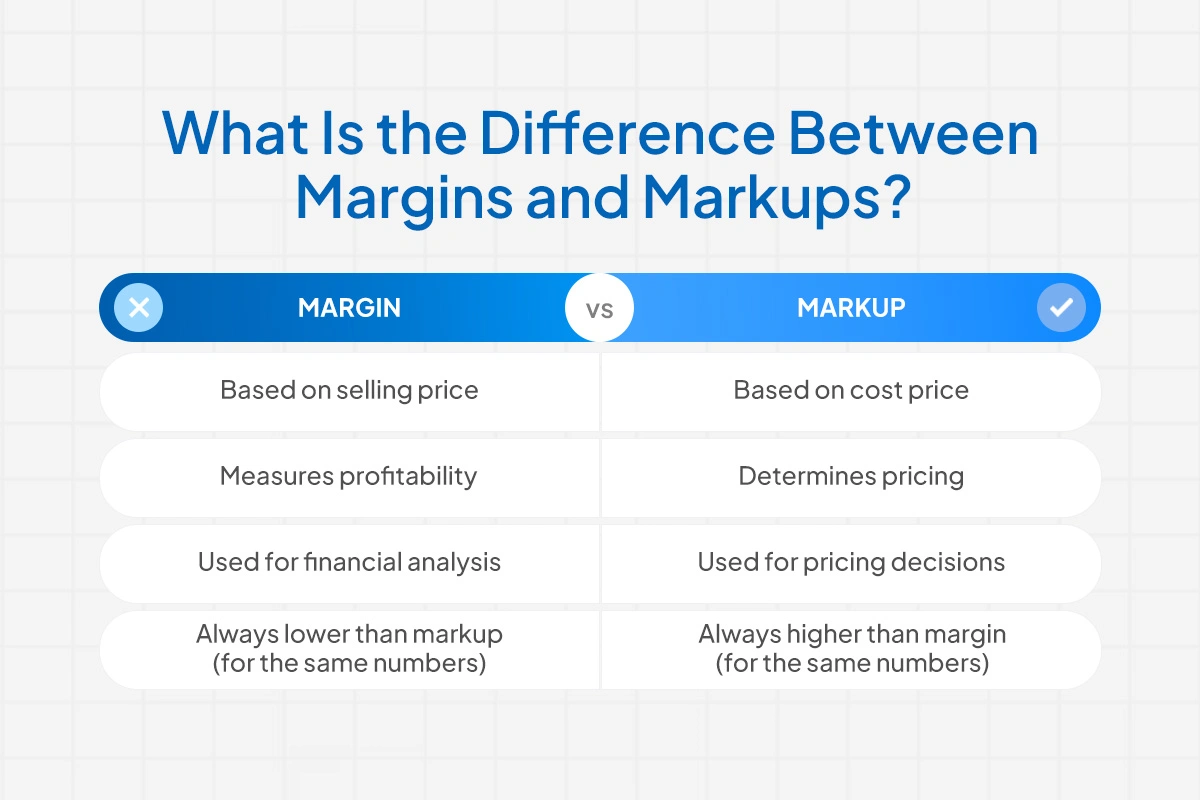
What Is the Difference Between Margins and Markups?
Markup and margin describe the same transaction from two different perspectives.
Markup measures how much you add to your cost:
Markup % = (Selling price − Cost) ÷ Cost × 100
Margin measures how much of the final selling price remains after the cost is deducted:
Margin % = (Selling price − Cost) ÷ Selling price × 100
Suppose a white label provider charges you $1,000 and you sell the service for $1,500.
- Your dollar difference is $500.
- Your markup is 50%.
- Your margin is only 33.3%.
To earn a 50% margin, a white label SEO agency must sell a $1,000 service for double of the price. This is crucial to generate impressive revenue with retention.
Gross Margin, Contribution Margin and Net Profit: What is the difference?
Gross margin subtracts fulfillment costs. The contribution margin also includes direct account expenses, whereas net profit deducts the agency’s broader overhead.
When pricing white label SEO services, contribution margin is usually the most useful number because it shows whether each account is actually supporting the business.
It helps to track profitability at three levels:
- Delivery gross margin: Revenue minus outsourced fulfillment and direct production costs.
- Account contribution margin: Revenue minus fulfillment, account management, project-specific tools, payment fees, support, and other costs attributable to that client.
- Net profit margin: What remains after general salaries, rent, marketing, insurance, taxes, and other business overhead.
When deciding how much to charge, the contribution margin is usually the most useful measurement. It shows whether the individual client is contributing enough money to support the rest of the agency.
How to Price Your White Label SEO Services?
A sustainable price should account for cost, risk, scope, and client value. Here is a practical process agencies can use.
1. Define the Exact Scope
Avoid selling a vague package called “monthly SEO.” Specify what the client receives. A defined scope makes the price easier to defend and reduces unplanned work.
Specify what is included, such as:
- Technical audits and implementation
- Keyword and competitor research
- On-page optimization
- Content briefs or finished content
- Local SEO and Google business profile work
- Reporting and monthly meetings
- Outreach, digital PR, or link acquisition
- Conversion recommendations
- Visibility monitoring across traditional search and AI search
- Support response times
- Revision limits
- Number of pages, locations, markets, or target keywords
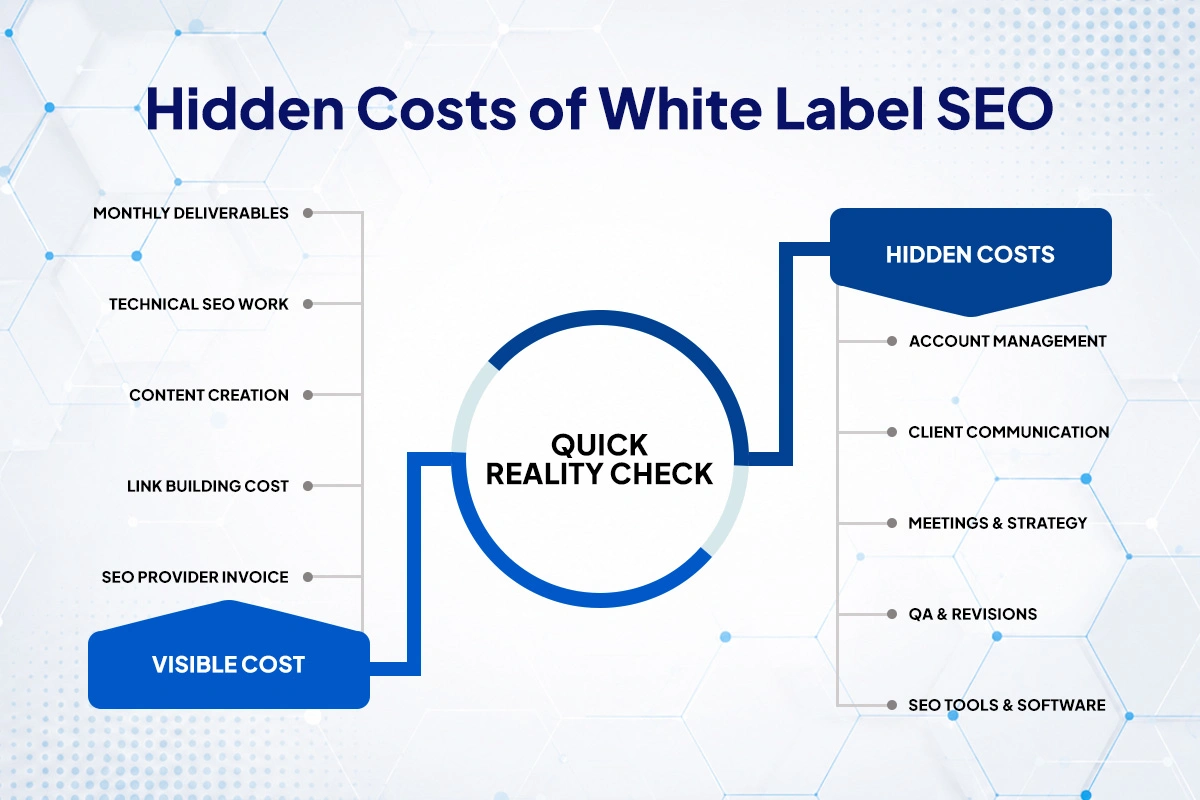
2. Calculate the Real Monthly Cost
The provider invoice is only one component of your cost. Use this formula:
Loaded delivery cost = Provider fee + Internal labor + Tools + Payment fees + Reporting + Support + Revision allowance + Risk reserve.
Your calculation should include:
- White label fulfillment fees
- Account manager time
- SEO strategist or Specialist time
- Quality assurance
- Client calls and email support
- Reporting and dashboard preparation
- Rank tracking, crawling, and backlink tools
- Content editing and uploading
- Developer support
- Publisher or placement fees
- Payment processing
- Currency conversion
- Sales commission
- Replacements, refunds, or service credits
- Client acquisition cost is spread across the expected relationship
Agencies often underestimate internal labor. Every hour spent reviewing work, reporting, or answering clients is a genuine cost.
Consider the $300 to $600 Example.
Assume the white-label service costs $300 per month, and the client pays $600. Your additional monthly costs may look like this:
| Monthly cost | Amount |
|---|---|
| Provider invoice | $300 |
| Payment processing | $18 |
| Account management | $80 |
| Strategy and quality assurance | $55 |
| Tool allocation | $25 |
| Reporting and administration | $20 |
| Revision and risk reserve | $30 |
| Total loaded cost | $528 |
Your real contribution is only $72, which equals a 12% margin.
If your target margin is 50%, a loaded cost of $528 requires a selling price of $1,056. That may be rounded to $1,050 or $1,095, depending on your offer and market positioning.
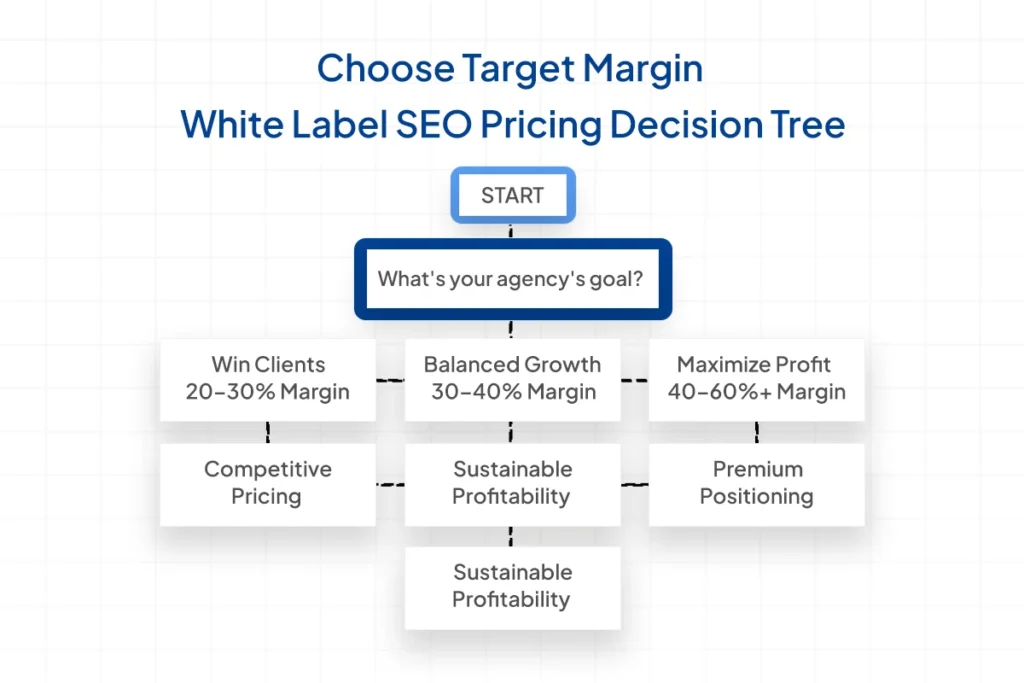
3. Choose a Target Margin
Your margin should reflect how standardized or customized the service is.
A productized, low-touch service may work at a 30% to 40% margin. Managed SEO with regular communication may require 40% to 50%. Competitive, consulting-heavy, or technically complex campaigns may need 50% to 60% or more.
The more responsibility your agency assumes for strategy, communication, and results, the more margin you need.
4. Calculate the Minimum Viable Price
Use this formula:
Minimum price = Loaded delivery cost divided by one minus the target margin.
If your loaded cost is $1,200 and your target margin is 50%, the minimum price is $2,400. That amount is your financial floor. You should then compare it with the value created for the client.
5. Price According to Client Value
Cost determines the lowest sustainable price. Value helps determine the final price.
Consider the value of an organic lead, average customer lifetime value, revenue influenced by organic search, competitive difficulty, geographic reach, and the cost of poor visibility.
Deciphering the Common white label pricing models
- Fixed monthly packages
The agency pays a predictable monthly amount for specified deliverables.
This model is suitable for recurring SEO, Monthly Link Building, content production, and local campaigns. It provides cost certainty but can create problems when clients with different complexity levels are placed in the same package.
- Per-deliverable pricing
The provider charges for each audit, article, landing page, citation, guest post, or link placement.
Per-deliverable pricing is flexible, but your agency must still charge for planning, selection, quality checks, and client communication. A link is not merely a line item. It requires contextual relevance, anchor planning, target-page selection, and ongoing monitoring.
- Hourly pricing
The provider charges for time spent on consulting, implementation, development, or technical analysis.
Hourly pricing works for unpredictable projects but makes margins harder to forecast. Your contract should include approval thresholds so that provider hours do not exceed the client budget.
- Project-based pricing
A one-time fee covers a defined project such as a technical audit, migration, content strategy, or authority analysis. Project work should include a buffer for discovery, revisions, and presentation time.
- Custom or enterprise pricing
Complex campaigns are typically priced after discovery.
This is common for multi-location companies, ecommerce sites, international campaigns, regulated industries, and large websites with several stakeholders.
What Do Most White Label SEO Services Actually Charge?
There is no standardized white label SEO price because two packages with the same name may contain entirely different levels of work.
A “local SEO package” might include basic citation work and reporting. Another provider may include technical implementation, location-page content, review management, backlinks, competitor research, and monthly strategy.
A June 2026 industry benchmark reported the following wholesale ranges:
- Local SEO: Approximately $300–$900 per month
- Mid-market SEO: Approximately $900–$2,500 per month
- Ecommerce and enterprise SEO: Approximately $2,500–$6,000 or more per month
The same research found that agencies frequently resell the work at two to three times the wholesale cost, although the appropriate multiple depends on what the agency adds to the service.
Factors That Influence White Label SEO Services Pricing
The cheapest provider is rarely the best provider for every client. Pricing is influenced by the resources and expertise required to create an acceptable outcome.
- Industry Competition
Competitive sectors require more research, stronger authority, better content, and more experienced experts.
A local home service company may need a lighter campaign than a national legal, finance, cybersecurity, casino, or healthcare brand. Regulated industries may also require compliance review, advanced publisher vetting, and specialist knowledge.
- Client Goals
The cost changes depending on whether the client wants to protect rankings, enter a new market, recover lost traffic, improve search engine Rankings, build topical authority, increase search traffic, or earn visibility in AI overviews and potential LLM citations.
- Website Condition
A technically healthy website is easier to improve than one with indexing problems, duplicate content, weak architecture, slow pages, JavaScript issues, or an inflexible CMS.
The site’s plugins, hosting, codebase, and Theme may also affect implementation time.
- Size and Complexity
A ten-page website should not be priced like a 50,000-product ecommerce store. Multi-location, multilingual, and international campaigns also require additional research, content writng, reporting, and coordination.
- Content Requirements
Content costs depend on research depth, subject expertise, editing, design, formatting, and approval processes.
AI can improve production Efficiency, but it should not replace original thinking, fact-checking, expert review, or human editing. High-performing content requires a useful perspective, not simply a large word count.
- Authority Building
A basic Backlink Service differs from a managed Off-Page SEO campaign.
Pricing depends on publisher relevance, organic traffic, editorial standards, geography, authority, content requirements, replacement terms, and the amount of manual outreach required.
A strong program includes competitor analysis, anchor planning, target-page selection, and quality control. These Strategic elements often matter more than the number of links purchased.
- Communication Level
A client who needs one monthly update costs less to manage than a client requesting weekly calls, custom reports, and same-day responses.
- Turnaround Time
Rush work requires additional resources and schedule changes. Faster delivery should carry a premium rather than silently reducing your margin.
How Much Should You Mark Up White Label Services and Stay Profitable?
There is no single correct markup for every service. The following ranges provide a practical starting point when applied to your loaded cost, not simply the provider invoice.
| Service type | Target account margin | Equivalent markup on loaded cost |
| Local SEO | 45%–55% | 82%–122% |
| Managed on-page SEO | 45%–55% | 82%–122% |
| Technical SEO retainers | 50%–60% | 100%–150% |
| One-time technical audits | 50%–65% | 100%–186% |
| SEO content production | 40%–55% | 67%–122% |
| Productized guest posts or niche edits | 35%–50% | 54%–100% |
| Managed organic link building | 45%–60% | 82%–150% |
| Digital PR | 45%–60% | 82%–150% |
| AI search and brand-mention campaigns | 50%–65% | 100%–186% |
| Full-service SEO retainers | 45%–60% | 82%–150% |
Common Errors Agencies Make While Deciding Their Pricing Models
- Applying Markup Only to the Provider Invoice
Many agencies calculate markup using only the provider invoice, overlooking account management, reporting, tools, and strategy. Calculate your full delivery cost first, then apply the target margin. This creates a more accurate, profitable, and scalable white label SEO pricing model.
- Using One Markup for Every Service
Local SEO, technical audits, content, link building, and digital PR require different workloads, expertise, and risk levels. Build service-specific pricing based on delivery effort, hidden costs, and client support instead of applying one markup across every white label SEO solution.
- Copying a Competitor’s Prices
Competitor pricing may look helpful, but you cannot see their costs, service quality, team structure, or profit goals. Use market rates as a reference, then set prices around your value, positioning, delivery model, and profit margin for sustainable agency growth.
- Ignoring Scope Creep
Small requests, extra reports, additional pages, and frequent calls can quietly destroy your margin. Define deliverables, revision limits, and support hours clearly. Use a simple change-order process so clients understand when additional SEO work requires a fair and transparent fee.
- Discounting Without Reducing Scope
Offering discounts without changing the workload makes your agency absorb the loss. When lowering the price, reduce deliverables, secure a longer contract, request advance payment, or limit support. This protects service quality, team efficiency, and your white label SEO margin.
- Failing to Review Account Profitability
A profitable client can become unprofitable as meetings, tool usage, revisions, or campaign requirements increase. Review every account’s contribution margin quarterly and before renewal. Adjust pricing, scope, or delivery processes early to protect retention, revenue, and consistent high-quality SEO results.
What If You Price Your Services Too Low?
Underpricing does more than reduce your profit. It changes how the service is delivered. When an agency lacks sufficient margin, it naturally starts looking for shortcuts:
- $20 guest posts on websites that receive little genuine traffic
- Unedited, AI-only content
- Automated audits without expert interpretation
- Generic reporting
- Reused strategies
- Inexperienced account managers
- Weak quality assurance
- Cheap vendors with unclear processes
- High-volume link packages with little relevance
- Reactive rather than proactive communication
AI Is Not the Problem, Poor Quality Control Is
AI-assisted content is not automatically low quality. The problem arises when automated output replaces research, experience, fact-checking, and human editing.
Cheap Link Building Can Create Bigger Risks
The same principle applies to link building. An Affordable placement can still be useful, but an unrealistically cheap placement often leaves no budget for prospecting, content, publisher review, negotiation, and quality control.
Low Pricing Can Attract the Wrong Clients
Low prices can also attract clients who evaluate SEO as a commodity. These Customers are more likely to compare deliverable counts, demand discounts, and leave when another provider offers a lower number.
More Clients Do Not Always Mean More Profit
Your team then needs more accounts to reach its revenue target. More accounts create more meetings, tickets, and reporting. Delivery quality declines, employees become overloaded, and client retention falls.
Growth Can Hide Falling Profitability
The agency may look like it is growing while becoming less profitable with every sale.
What Should You Do Instead?
- Calculate the full cost of delivering white label SEO services, including tools, account management, reporting, revisions, payment fees, and internal team time.
- Decide on a minimum profit margin before building packages, quoting new clients, or offering discounts.
- Use AI to save time, but keep human research, editing, fact-checking, and quality control in the process.
- Choose relevant and trustworthy publishers instead of buying cheap backlinks just to reach a monthly target.
- Set clear limits around deliverables, revisions, meetings, response times, and additional work before the campaign starts.
- When a client asks for a lower price, reduce the scope instead of delivering the same amount of work for less money.
- Review the profitability of every account regularly and adjust pricing when workloads, tool costs, or client requirements increase.
Why Is It Crucial to Have the Right Pricing Strategy?
The right price gives your agency the resources to keep its promises. Healthy margins allow you to:
- Hire and retain skilled people
- Use reliable SEO and reporting tools
- Perform meaningful quality checks
- Replace failed deliverables
- Invest in training
- Give clients thoughtful advice
- Test new strategies
- Respond when search platforms change
- Improve operational Efficiency
- Maintain consistent service during busy periods
- Scale without overwhelming the team
When white label SEO services are priced properly, growth becomes easier to manage, and every new account strengthens the business instead of draining it. Fair pricing protects quality, improves retention, and creates relationships with clients who value expertise over bargain rates.
TakeAway
A top agency does not select a random markup and hope the numbers work. It understands the cost of delivery, knows the value it adds, and builds a pricing model that supports long-term performance.